



See Our Latest Posts and News
Access our FREE Articles and Learning Library of content
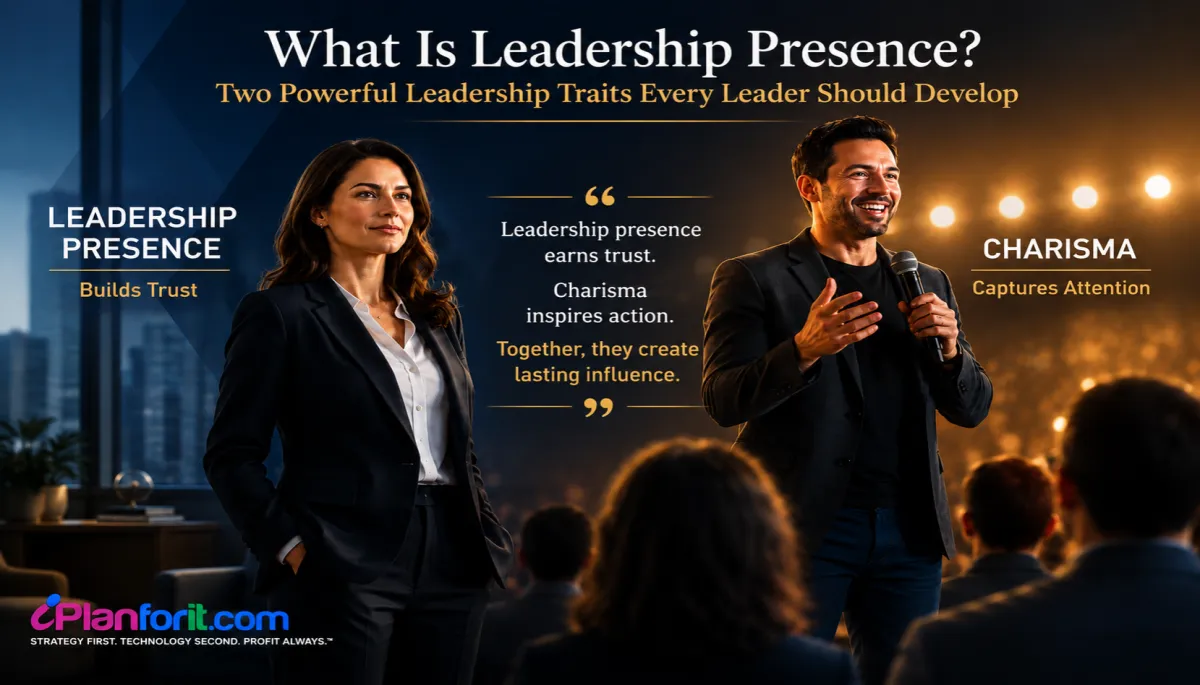
Two Powerful Leadership Traits Every Leader Should Develop
The iPlanForIt Leadership Series
Leadership, Personal Development
What Is Leadership Presence?
Understanding the Difference Between Leadership Presence and Charisma; and Why Great Leaders Develop Both
Leadership presence earns trust. Charisma inspires people to act. Together, they create lasting influence.
Some leaders earn trust before they ever speak.
Others can energize an entire room the moment they begin.
The most effective leaders learn to do both.
Leadership presence and charisma are often confused because they influence people in different ways. Presence creates confidence. Charisma creates momentum. One builds trust. The other inspires action.
The strongest leaders don't choose between them.
They develop both.
It's one of those qualities people recognize instantly and struggle to define. Most people confuse it with charisma. They are not the same thing, and understanding the difference can change how you show up at work, how you lead a team, and how much influence you actually carry, whether or not you're the loudest voice in the room.
Think about the leaders you've trusted most in your career. Were they the ones who commanded every room with big energy or the ones who made you feel like your problem actually mattered the moment you brought it to them?
For most of us, the answer depends on the situation. We appreciate leaders who inspire us, but when uncertainty arrives, we instinctively look for the one we trust and who, in my experience, is often the person ultimately responsible for making the decision.
Charisma makes people say, "I like this person, I want to work with them."
Presence makes people say, "I trust this person to lead the company and make the right decisions for its future."
Those are not the same sentence, and only one of them survives a genuine crisis.

What Leadership Presence Actually Is
Leadership presence is the felt impact you have on others when you walk into a room, speak, listen, or make a decision. It's the combination of how you carry yourself, how clearly you communicate, and how consistently your actions match your stated values.
In my experience, people with strong leadership presence are rarely the most extroverted individuals in the workplace. More often, they are the owners, presidents, CEOs, or senior executives whose judgment ultimately shapes the organization's direction.
At its core, presence blends three elements:
Credibility — you know your subject well enough that people trust your read on it.
Connection — you make people feel genuinely seen and heard, not just processed.
Composure — you stay grounded when the pressure is real.
When all three are visible and consistent, people experience you as trustworthy and impactful even if you speak softly or would honestly rather not be the center of attention at all.
Unlike a title, presence isn't handed to you by an org chart. It's built in the small, repeatable moments: how you open a meeting, how you respond to disagreement, how you handle genuine uncertainty, how you deliver a decision nobody's going to love. Those moments compound, over months and years, into a clear impression of who you actually are as a leader and whether people feel safe following you into something hard. You speak with confidence and clarity. People understand the decision has been made.
Presence shows up in three layers:
Physically — posture, eye contact, calm and intentional movement that signals you're actually present, not just physically in the room.
Mentally — the ability to focus, listen deeply, and respond thoughtfully instead of reacting on impulse.
Emotionally, the steadiness and empathy leaders bring, especially when situations are tense, uncertainty is high, and employees need reassurance.
Pro Tip: Ask a colleague you trust, "How do I come across in high-pressure moments?" Their honest answer is often the clearest window you'll get into your current leadership presence.
Before we compare presence and charisma, it's worth recognizing something that's changing the way we work and lead.
In a world where AI can write emails, create presentations, analyze data, summarize meetings, and automate countless tasks, authentic leadership presence becomes even more valuable because it's one of the few things technology can never replace.
As AI becomes more capable, the qualities that make us deeply human become even more important. People don't follow leaders because they use the newest technology. They follow leaders because they trust them. They remember who listened, who remained calm under pressure, who treated them with respect, who was empathetic to their needs, and who made them feel seen. Technology can improve efficiency. It cannot replace character, empathy, or genuine human connection.
The more capable AI becomes, the more valuable authentic leadership becomes. Technology will continue to reshape how we work. It will never replace why people choose to follow someone.

Leadership Presence and Charisma: Different Strengths, Shared Purpose
Leadership Presence
Builds trust
Creates stability
Projects confidence
Encourages thoughtful decisions
Helps people feel safe
Charisma
Inspires action
Energizes people
Creates enthusiasm
Captures attention
Communicates vision
Neither one replaces the other.
The best leaders become fluent in both.
Charisma without presence may inspire people initially but can be difficult to sustain over time.
Presence without charisma may build trust but can struggle to generate enthusiasm. Together, they create lasting influence. Presence without charisma can become invisible.
Exceptional leaders know when people need reassurance and when they need inspiration.
The best leaders become fluent in both and know when to play each role.
Charisma is magnetic charm: the ability to captivate a room, tell a great story, energize a crowd. It's powerful, and it's also situational; it sets the energy in the room for the information that follows. Charisma draws attention. It also can build trust and loyalty on its own.
In today's workplaces, where teams are often distributed, change is constant, and leaders face increasingly complex decisions, organizations need both inspiration and stability. Employees want leaders who can communicate a compelling vision, provide clear direction, make thoughtful decisions, and remain steady when circumstances change. This is where leadership presence and charisma work together. Charisma inspires people to embrace the vision and take action. Leadership presence builds the trust and confidence that sustain momentum when challenges arise. Together, they help organizations navigate uncertainty with resilience, confidence, and clarity.
Over time, the differences become easier to recognize, and the best leaders learn to develop both.
Leadership presence builds trust; charisma creates momentum. Presence gives people confidence in your judgment. Charisma helps people believe in the vision and take action. Together, they create both commitment and progress.
Leadership presence provides stability; charisma generates energy. During periods of uncertainty, people look for calm, thoughtful leadership. During times of growth or change, they also need enthusiasm and optimism. Exceptional leaders know when their teams need reassurance and when they need inspiration.
Leadership presence listens first; charisma communicates gently. Presence encourages thoughtful conversations, active listening, and sound decision-making. Charisma helps leaders share ideas with passion, rally people around a common purpose, and inspire others to move forward. The most effective leaders know how to do both.
The encouraging news is that both leadership presence and charisma can be developed. Neither is reserved for a select few.
Leadership presence grows through self-awareness, emotional intelligence, consistency, and experience. It develops when you learn to slow down before you speak, listen with genuine intent, remain composed under pressure, and ensure your actions consistently reflect your values. Over time, those habits build credibility, trust, and confidence in your leadership.
Charisma also grows with intention. It develops as you become a more confident communicator, learn to tell meaningful stories, express genuine enthusiasm, communicate a compelling vision, and inspire others to believe in what's possible. Authentic charisma isn't about being the loudest person in the room; it's about helping people feel energized, connected, and motivated to move forward.
You don't need to change your personality to become a stronger leader. Whether you're naturally quiet or naturally outgoing, you can strengthen both your leadership presence and your ability to inspire others.
The most influential leaders earn trust through their presence and create momentum through their communication. They know when people need reassurance, when they need inspiration, and how to bring both with authenticity.
At iPlanForIt, we've worked with leaders across many industries and organizations. The ones who build the strongest companies aren't defined by one leadership trait alone. They earn trust through their presence, inspire action through their communication, and know when each is needed to help their people succeed.
Key Takeaway: Leadership presence and charisma are not competing leadership styles. They are complementary strengths. Presence earns trust. Charisma inspires action. The most influential leaders develop both, knowing when each is needed to serve their people and their mission.
My Reflection
Throughout my career, I've had the opportunity to work alongside founders, CEOs, presidents, and business owners. One pattern I've observed repeatedly is that leadership presence and charisma often exist in different people, and the strongest organizations learn to leverage both.
I've learned that leadership presence isn't something you put on before walking into a meeting. It's something you cultivate long before anyone else arrives. It grows quietly through character, consistency, humility, and the way you treat people when there's nothing to gain. Over time, those small moments become your reputation. And in my experience, reputations built on trust last far longer than impressions built on charisma.
I've worked with leaders who could command a stage and others who rarely sought the spotlight. Both left lasting impressions, but for different reasons. Some inspired people to believe in a vision. Others created the confidence to follow through when the work became difficult. The most memorable leaders were able to do both.
I think about that difference constantly now, especially in moments that feel tense or uncertain. Anyone can perform confidence when things are going well. Presence is what's left when they're not. It's the composure that doesn't perform for an audience; it's just who you've decided to be, on the hard days and the easy ones both.
Over the years, I've had the opportunity to lead in different ways. Sometimes my role was to bring calm and clarity. Other times it was to energize people around a vision or help them believe they could accomplish more than they imagined. Both mattered.
I've learned that leadership isn't about choosing between presence and charisma. It's about knowing when people need confidence and when they need encouragement. When they need stability and when they need inspiration.
Leadership presence earns trust.
Charisma inspires people to act.
The leaders people remember most learn to bring both with authenticity.
The question isn't whether you're naturally more charismatic or naturally more reserved. The question is whether you're intentionally becoming the leader your people need you to be.
At the end of our careers, people won't remember every presentation we gave or every decision we made.
They'll remember how they felt when they were led by us.
That's the legacy worth building.
Daisy Finazzo
iPlanForIt
Strategy First. Profit Always.™ Helping business owners build more profitable, valuable, and transferable companies.
© 2026 iPlanForIt, Inc. All rights reserved.

Driving Growth, Amplifying Impact

CHOOSE HOW YOU WANT TO WORK WITH US
BUILD A STRONGER, MORE VALUABLE BUSINESS.
We uncover hidden profit opportunities, reduce unnecessary expenses, strengthen operations, implement AI strategically, and help owners build more profitable, valuable, and transferable companies.
Our mission is simple: help business owners turn untapped potential into stronger performance, sustainable growth, and greater long-term enterprise value.