



See Our Latest Posts and News
Access our FREE Articles and Learning Library of content
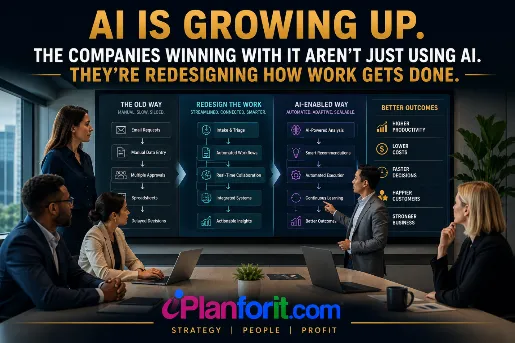
AI Is Growing Up: The Companies Winning With It Aren't Just Using It. They're Redesigning How Work Gets Done
Artificial Intelligence, Future of Work, Business Strategy
AI Is Growing Up: The Companies Winning With It Aren't Just Using It. They're Redesigning How Work Gets Done
A few years ago, simply using artificial intelligence could make a company feel like it was ahead of the curve. Today, that's no longer enough, and the data now makes that impossible to ignore.
The Question Every CEO Should Be Asking Differently
AI can write an email. Summarize a meeting. Analyze a document. Draft marketing copy. Research a competitor. Millions of employees are already doing all of it.
Those capabilities are useful. They save time. They make individual people faster.
But using AI and building a better business with AI are two very different things.
Here's the uncomfortable part: that distinction is no longer theoretical. AI use across U.S. businesses has climbed to roughly 17–20%, with the Census Bureau's Business Trends and Outlook Survey projecting up to 23% adoption within six months; in knowledge-intensive sectors like finance, professional services, and information, usage already reaches 50–70% when weighted by employment. Adoption is no longer the finish line. It's table stakes.
So if most of the market is already "using AI" in some capacity, saying your company uses it doesn't tell anyone very much anymore.
The more important question is: what actually changed because of it?
Did your conversion rate improve? Did customer response time decline? Did operating costs improve? Did margins improve? Did the business become easier to scale?
Those are business questions, not technology questions, and that's exactly how AI should be judged.

Productivity Is Good. Enterprise Value Is Better.
This distinction matters more than most leadership teams realize.
McKinsey reports that nearly 90% of organizations are experimenting with AI, but only 7% say they've scaled it across the enterprise. The firms that redesigned workflows around AI, rather than layering it on top of old ones, were 5.3 times more likely to report real enterprise value capture.
Deloitte's 2026 State of AI research shows the same divide from a different angle: 37% of organizations are using AI in fairly superficial ways, while 34% are using it to deeply transform the business and another 30% are actively redesigning processes around it. Worker access to AI tools jumped from under 40% to roughly 60% in a single year, but access isn't the same as advantage.
Picture giving 100 employees an AI assistant. Each one becomes a little faster at writing, researching, and answering questions. That's valuable. But the underlying business may still run almost exactly as it did before: the same approvals, the same handoffs, the same duplicate data entry, the same customer bottlenecks, the same five people involved in a decision that should require two.
You've improved individual productivity without improving the business's architecture. That's the difference between adding AI to work and redesigning work to take advantage of what's now possible.
What the Leading Companies Are Actually Doing Differently
Enterprise deployment is maturing fast. Among enterprises with revenue above $500 million, 72% now have at least one AI system in production, up from 49% two years ago, running an average of 3.4 AI initiatives simultaneously, with more than half grounding their outputs in their own data. And it's paying off: 64% of enterprises now report measurable positive ROI from AI, up from 43% just a few years earlier.
But the companies pulling ahead of that pack share a few specific habits:
They start with outcomes, not features. Leading firms don't ask "where can we use a chatbot?" They ask, "How do we cut resolution time in half?" or "How do we grow revenue per customer by 20%?" and then design AI into the process to deliver that specific result.
They build AI into how the business actually runs, not as a side tool. Roughly 70% of AI builders now focus on vertical, workflow-integrated applications rather than the underlying models themselves. Differentiation increasingly comes from workflow design and domain expertise, not from access to the newest model.
They manage cost and quality deliberately, often routing simple tasks to smaller models and reserving expensive, powerful ones for complex work, keeping margins healthy without sacrificing quality where it counts.
They're rethinking entire processes, not just individual tasks. In customer service, AI increasingly reads incoming messages, classifies intent, pulls history, and drafts a response, escalating only the genuinely complex cases to a human, who now spends more time on empathy and judgment and less on triage. In operations, AI is shifting teams from reactive work to supervising predictive systems. Nearly half of enterprise applications are expected to include task-specific AI agents that don't just assist with a step; they own an outcome.
Real-world results back this up. Nvidia has announced partnerships to facilitate more than $500 billion in third-party financing for AI infrastructure. Lloyds Banking Group has outlined a strategy targeting roughly £2 billion in cost savings through 2030, built in part on AI. Capgemini raised its 2026 revenue growth target as clients shift from isolated AI experiments to full strategic transformation.
One governance note leaders can't ignore: only about one in five companies has mature governance for autonomous AI agents, even as those systems move closer to core business decisions. Clear accountability, escalation paths, and decision rights are no longer optional; they're catching up to capability, and they need to catch up faster.

Don't Automate a Bad Process
There's an old business lesson that matters even more with AI: automating inefficiency doesn't eliminate inefficiency; it just makes it move faster.
If your onboarding process already has unnecessary steps, adding AI won't make it better. If your sales process is poorly defined, AI doesn't manufacture sales discipline. If your data is bad, AI simply analyzes bad data faster. If no one owns a process today, automating parts of it doesn't fix the accountability problem.
This is why operational excellence still matters as much as it ever did. Companies that combine advanced technology with strong operational discipline are outperforming companies that treat the two as separate initiatives. Technology is an accelerant, but before you accelerate something, you'd better make sure it's pointed in the right direction.
Start With Economics, Not With AI
This is where most businesses have the order backward. They start by asking, "Where can we use AI?"
The better starting question is: "Where does this business have the greatest opportunity to improve its economics?"
That's the core idea behind the Profit Accelerator Framework we use at iPlanForIt, examining the economic drivers inside a business: pricing, conversion, retention, transaction value, productivity, operating costs, margins, and customer relationships, where relatively small, compounding improvements add up to significant results.
Once you know where the real economic leverage sits, AI becomes a far more useful conversation. Could it improve conversion? Reduce response times? Flag churn earlier? Shorten the time between spotting a problem and acting on it? Now you're applying technology to a measurable business opportunity, not implementing AI just because it's interesting.
The Human Role Doesn't Disappear. It Moves Upstream.
As AI absorbs more routine cognitive work, human judgment doesn't become less important; it becomes more concentrated.
Someone still has to decide what outcome actually matters. Someone has to judge whether the AI's recommendation makes sense. Someone has to understand the customer, make the ethical call, catch the exception the system didn't anticipate, lead the people affected by the change, and remain accountable when the decision is wrong.
The best AI operating models won't minimize human involvement; they'll become far more deliberate about where human involvement creates the greatest value. Let the technology do what it does exceptionally well. Let people spend more time on what requires judgment, relationships, creativity, and accountability. That isn't replacing people. That's redesigning work.
Real-World Case Study: Redesigning the Metric, Not Just the Tool
A Microsoft Advertising case study involving Lenovo offers a clean illustration of the difference between using AI and redesigning around it. Rather than simply layering an AI writing tool onto existing campaigns, the initiative centered on AI-driven campaign optimization, restructuring how targeting, bidding, and creative decisions were made in the first place.
The result: a 106% increase in return on ad spend and a 104% increase in conversion rate.
Notice what wasn't being measured: how many people used the AI tool, or how many pieces of content it produced. The metric that mattered was the business outcome, return on spend and conversion, because the process itself had been rebuilt around what AI made possible, not simply accelerated in its old form.
That's the pattern worth studying, regardless of industry: the companies seeing outsized results aren't the ones with the most AI activity. They're the ones that changed what the process was optimized for.

Don's Perspective
I've watched technology change business repeatedly over more than four decades. The tools change. The terminology changes. The speed changes. But one principle remains remarkably durable: a tool becomes valuable only when it helps produce a better outcome.
That's why I think the AI conversation needs to mature. We don't need another year of CEOs asking whether their employees have tried AI. We need executives asking harder questions:
What work should no longer be done the way we're doing it?
Where are customers waiting unnecessarily?
Where are employees spending time on work that doesn't require their judgment?
Where are we making decisions without using information already sitting inside our own company?
Where are margins being lost because a process hasn't evolved?
Where could technology make the organization faster without making it careless?
And perhaps most importantly: if we were building this company from scratch today, with everything now available to us, would we design it this way?
That question can be uncomfortable. It can also be incredibly valuable. I don't believe the next generation of successful companies will be the ones with the most AI. I believe they'll be the ones that become exceptionally good at deciding what people should do, what technology should do, and where the two should work together, because the real opportunity isn't artificial intelligence itself. The opportunity is building a better business because artificial intelligence now exists. Those are two very different things.
Where This Leaves You
Stop asking whether your people are using AI. Start asking how fundamentally you're willing to rethink how work flows through your organization now that AI exists.
Pick one end-to-end process: onboarding, collections, customer support, quoting, and redesign it assuming AI is available at every step, not bolted onto the end of it. Put governance in place before you scale, not after. And before any of that, get honest about where your business actually loses money and time today, because that's where AI will pay for itself first.
If you want a clear-eyed look at where your business has the greatest economic leverage, with or without AI in the mix, that's exactly what a strategy call is for.
Strategy First. Profit Always.™
Helping business owners build more profitable, valuable, and transferable companies. © 2026 iPlanForIt, Inc. All rights reserved.

Driving Growth, Amplifying Impact

CHOOSE HOW YOU WANT TO WORK WITH US
BUILD A STRONGER, MORE VALUABLE BUSINESS.
We uncover hidden profit opportunities, reduce unnecessary expenses, strengthen operations, implement AI strategically, and help owners build more profitable, valuable, and transferable companies.
Our mission is simple: help business owners turn untapped potential into stronger performance, sustainable growth, and greater long-term enterprise value.