



See Our Latest Posts and News
Access our FREE Articles and Learning Library of content
SOPs: Essential for Small Business Growth
Small Business, SOPs, Standard Operating Procedures, Operations
Standard Operating Procedures (SOPs): Why Every Small Business Needs Them
The Secret Weapon Behind Consistency, Scalability, and Business Freedom
SOPs might not be the most exciting topic in business, but they are one of the most powerful. Behind every smooth-running company, profitable operation, and scalable organization is a set of documented systems that ensure work gets done the right way every time.
Many business owners believe Standard Operating Procedures (SOPs) are only for large corporations. The reality is exactly the opposite. Small businesses often need SOPs even more because they have fewer people, less margin for error, and less time to waste fixing preventable mistakes.
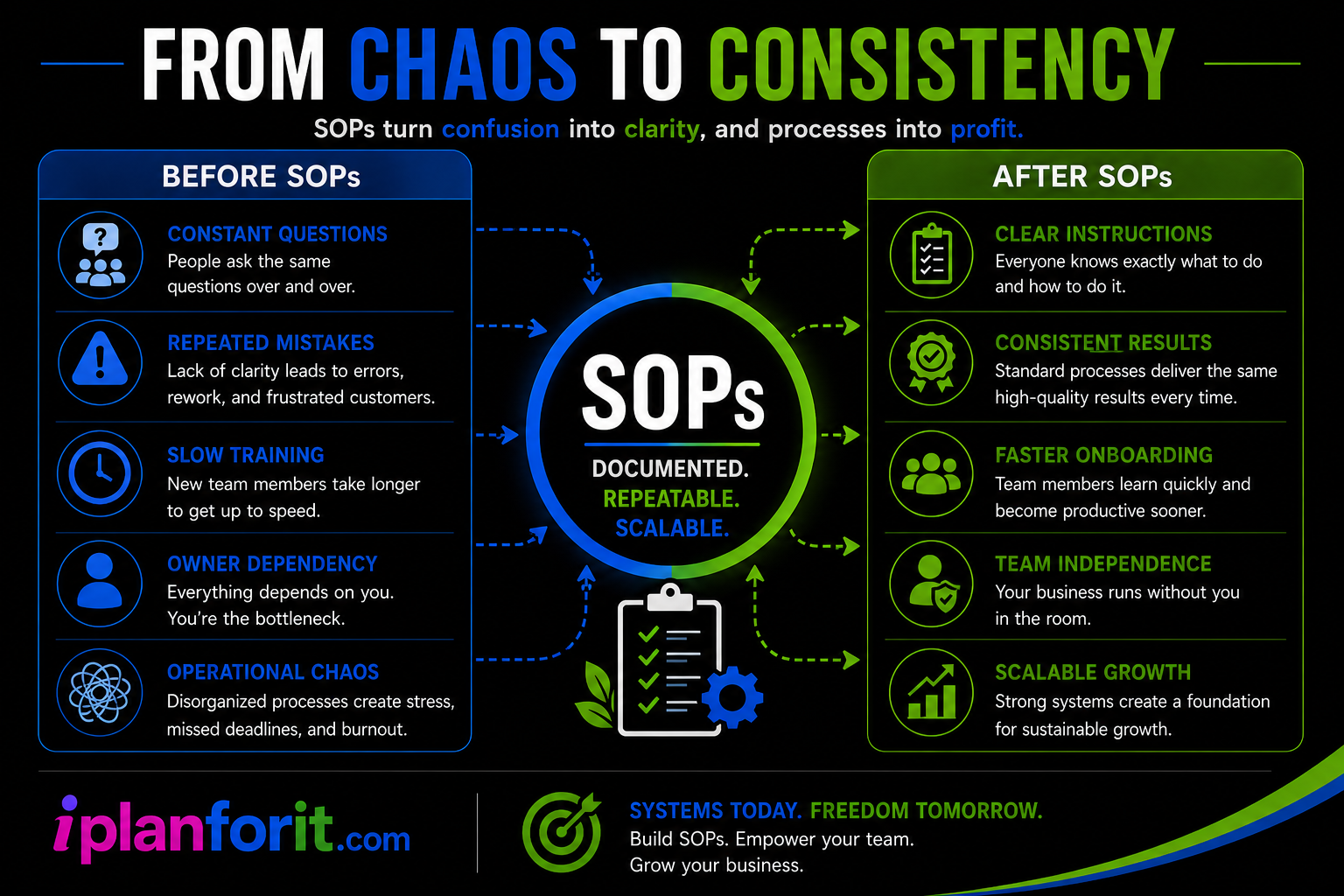
If your business depends on memory instead of systems, growth becomes difficult, delegation becomes risky, and every day feels like firefighting. SOPs change that.
What Are SOPs (Standard Operating Procedures) in Plain English?
A Standard Operating Procedure (SOP) is a documented set of instructions that explains how to complete a specific task or process consistently.
Think of SOPs as your company's operating manual.
They capture the best way to perform recurring tasks and ensure everyone follows the same process regardless of who is doing the work.
An SOP can be:
• A checklist for onboarding a new client
• A guide for handling customer complaints
• A sales call script
• A video walkthrough for software usage
• A detailed process for fulfilling orders
• A procedure for opening or closing the business each day
The format matters less than the outcome. The goal is clarity, consistency, and repeatability.
Quick Definition
SOPs are written, step-by-step instructions that show your team exactly how to perform routine tasks correctly and consistently.
Why Every Small Business Needs SOPs
1. SOPs Get the Business Out of Your Head
If employees constantly ask:
How do I process this refund?
Where do I save this file?
What should I tell this customer?
Then your business is operating on memory rather than systems.
When critical knowledge exists only in the owner's mind, the owner becomes the bottleneck.
SOPs transfer knowledge from people into processes, allowing your business to function without requiring constant supervision.
2. SOPs Create Consistency
Customers come back when they know what to expect. If one barista makes an incredible latte and another makes something average, you don’t have a product; you have a lottery. SOPs standardize how things are done so every customer gets the same level of quality every time, regardless of who’s working that day.
That consistency builds trust, loyalty, and word-of-mouth referrals—the real drivers of growth for small businesses without huge marketing budgets.
Customers expect a predictable experience.
Whether they work with your best employee or your newest employee, the outcome should be the same.
Without documented processes, quality becomes inconsistent.
With SOPs, everyone follows the same proven approach, creating a more reliable customer experience and stronger brand reputation.
3. SOPs Accelerate Training
Training new employees becomes dramatically easier when documented processes are already in place. Without SOPs, every new hire means weeks of shadowing, repeating instructions, and correcting avoidable mistakes. With SOPs, you can hand them a clear set of procedures and say, “Follow this, and ask questions if anything’s unclear.”
That doesn’t replace good leadership, but it gives new people a strong baseline. It also reduces the risk that important steps get missed simply because someone “forgot to mention it” during training.
Instead of relying solely on verbal instruction, new team members can learn from:
Checklists
Videos
Process maps
Written guides
This reduces training time and increases confidence.
4. SOPs Reduce Errors
Mistakes cost money.
They create rework, refunds, customer frustration, and employee stress.
SOPs reduce mistakes by removing guesswork and establishing clear expectations.
Checklists catch what memory misses.
5. SOPs Make Your Business More Valuable and Sellable
One day, you might want to sell your business, bring in a partner, or step back from daily operations. A company that runs on SOPs is far more attractive to buyers and investors than one that only works because “Sarah knows how to do everything.”
Documented Standard Operating Procedures show that your results are repeatable and not dependent on any single person. That’s the difference between owning a job and owning an asset.
Documentation creates confidence.
When a process is clearly defined, delegation becomes much easier and more effective.
6. SOPs Create Freedom for Business Owners
One of the biggest reasons entrepreneurs start a business is to gain freedom. Ironically, many end up creating a job that cannot function without them.
If your phone constantly rings when you're away, if employees need your approval for every decision, or if taking a vacation feels impossible, your business is too dependent on you.
SOPs change that.
When responsibilities are documented and processes are clear, your team can operate with greater confidence and independence. Decisions get made faster, problems get solved sooner, and daily operations become less reliant on the owner.
The goal is not to remove yourself completely from the business. The goal is to remove yourself as the bottleneck.
A business that can run smoothly while you step away for a day, a week, or even a month is a business built for long-term success.
Freedom is not created by working harder.
Freedom is created by building systems that work without you.

Simple, visible SOP checklists turn good intentions into everyday habits.
Real-Life Examples: How Small Businesses Use SOPs to Win
Theory is nice, but stories are better. Here are real-world style examples of how small businesses use SOPs to solve everyday problems, grow faster, and keep their sanity intact.
The Local Café That Eliminated Morning Chaos
A neighborhood café struggled with inconsistent openings.
Some mornings, everything was ready.
Other mornings:
The espresso machine wasn't warmed up
Pastries weren't displayed properly
Tables weren't prepared
The owner decided to create a simple Opening Shift SOP. It included:
Exact time to turn on the espresso machine and ovens
Step-by-step checklist for displaying pastries and labeling allergens
Quick cleaning and table setup routine before doors open
Standard greeting and “first order” process for the first five customers
They printed the SOP as a one-page checklist and clipped it near the register. Within two weeks, opening delays dropped dramatically, staff felt more confident, and the café started getting online reviews mentioning “fast, friendly service, even during the morning rush.”
The solution wasn't hiring more people.
It was creating a better process.
The Marketing Agency That Stopped Losing Clients
A growing marketing agency constantly battled missed deadlines, lost files, and communication breakdowns.
They created three SOPs:
Client onboarding
Campaign launch procedures
File naming and storage standards
Within a month:
Deadlines improved
Team communication improved
Client satisfaction increased
Capacity expanded
Their SOPs didn't slow them down.
They freed them up.
The Home Services Business That Reduced Refunds by 40%
A small home cleaning company kept running into the same issue: customers calling back to say, “You missed this room,” or “The bathroom wasn’t cleaned properly.” The owner often ended up sending a cleaner back for free, eating into profits and frustrating the team.
They created a Standard Cleaning SOP for each job type (studio apartment, two-bedroom home, move-out clean). Each SOP included:
A room-by-room checklist of tasks (e.g., “wipe baseboards,” “clean inside microwave,” “vacuum under sofa if movable”)
Standard products and tools to use for each surface, to avoid damage or inconsistency.
A final “walkthrough” step where cleaners take photos of key areas before leaving
After rolling out the SOPs and training the team, refund-related callbacks dropped by about 40% over three months. The owner could now confidently market a “satisfaction guarantee” because the process backed it up.
The 5 SOPs Every Small Business Should Create First
If you're just getting started, focus on these five high-impact areas:
1. New Client Onboarding
Document every step from the signed agreement to the project kickoff.
2. Service Delivery or Fulfillment
Ensure products and services are delivered consistently.
3. Customer Complaint Resolution
Create a repeatable process for resolving issues professionally.
4. Invoice Creation and Collection
Reduce payment delays and improve cash flow.
5. New Employee Onboarding
Help new hires become productive faster.
What Makes a Great SOP?
Every SOP should include:
Title and Purpose
What is the process, and why does it exist?
Scope
When should this SOP be used?
Responsibility
Who owns the process?
Step-by-Step Instructions
Simple, numbered actions.
Tools and Resources
Links, templates, forms, and software required.
Quality Checks
How do you verify the process was completed correctly?
Review Date
When was the SOP last updated?
Key Takeaway
A great SOP should be clear enough for a new employee to follow successfully with minimal assistance.
How to Create SOPs Without Becoming Overwhelmed
Step 1: Start With Frustration
Identify the tasks that:
Create the most mistakes
Consume the most time
Generate the most complaints
Start there.
Step 2: Observe the Process
Watch the task being completed.
Document every step.
Step 3: Write Simple Instructions
Use plain language.
Avoid jargon.
Focus on clarity.
Step 4: Test It
Have someone unfamiliar with the process follow the SOP.
Refine based on feedback.
Step 5: Store It Where Everyone Can Find It
Popular options include:
Notion
Google Drive
Trainual
ClickUp
Asana
The best SOP is useless if nobody can find it.
Common Myths About SOPs
"SOPs Kill Creativity"
No.
SOPs standardize routine tasks so people can focus their creativity where it matters most.
"We're Too Small for SOPs"
Small businesses often benefit the most because every mistake has a larger impact.
"I Don't Have Time"
Create one SOP per week.
Within three months, you'll have a valuable operating system that saves hours every single week.
Your Next Move: Start with Just One SOP This Week
You don’t need a giant operations manual to feel the benefits of SOPs. Pick one area that constantly causes headaches, maybe it’s onboarding a new client, closing the shop, or handling refunds. Watch how it’s done, write down the steps, test it, and put it where everyone can find it.
That single Standard Operating Procedure will already make your small business more consistent, more professional, and less stressful. Then, week by week, you can add more. Over time, you’ll build a business that doesn’t just survive on your effort; it thrives on clear, repeatable systems.
The goal of SOPs is not to create paperwork. The goal is to create consistency, reduce stress, and build a business that can grow without depending on you for every decision.
The Bottom Line
Most small businesses do not have a people problem.
They have a documentation problem.
The more your business depends on memory, the harder it becomes to scale.
The more your business depends on systems, the easier it becomes to grow, delegate, and eventually step away.
Every SOP you create today is an investment in future efficiency, future freedom, and future business value.
The businesses that grow sustainably are not necessarily the ones with the most talented people.
They are the ones with the clearest systems.
Remember:
Consistency beats improvisation.
Systems beat memory.
Documentation beats dependency.
Process creates freedom.
Ready to Build a Business That Runs Without Constant Firefighting?
At iPlanforit, we help business owners build the systems, processes, and operational foundations that enable sustainable growth.
Whether you're looking to improve efficiency, delegate with confidence, reduce operational stress, or prepare your business for an eventual sale, we can help.
Schedule Your Complimentary Strategy Session
🔗 iplanforit.com/strategy-call-15min
STRATEGY FIRST! PROFIT ALWAYS!

Driving Growth, Amplifying Impact

Unleash Your Business Brilliance.
I believe every business has untapped potential.
My mission is to help business owners uncover it, accelerate growth, increase profitability, and build more valuable, scalable, and future-ready companies.