



See Our Latest Posts and News
Access our FREE Blog and Learning Library of content
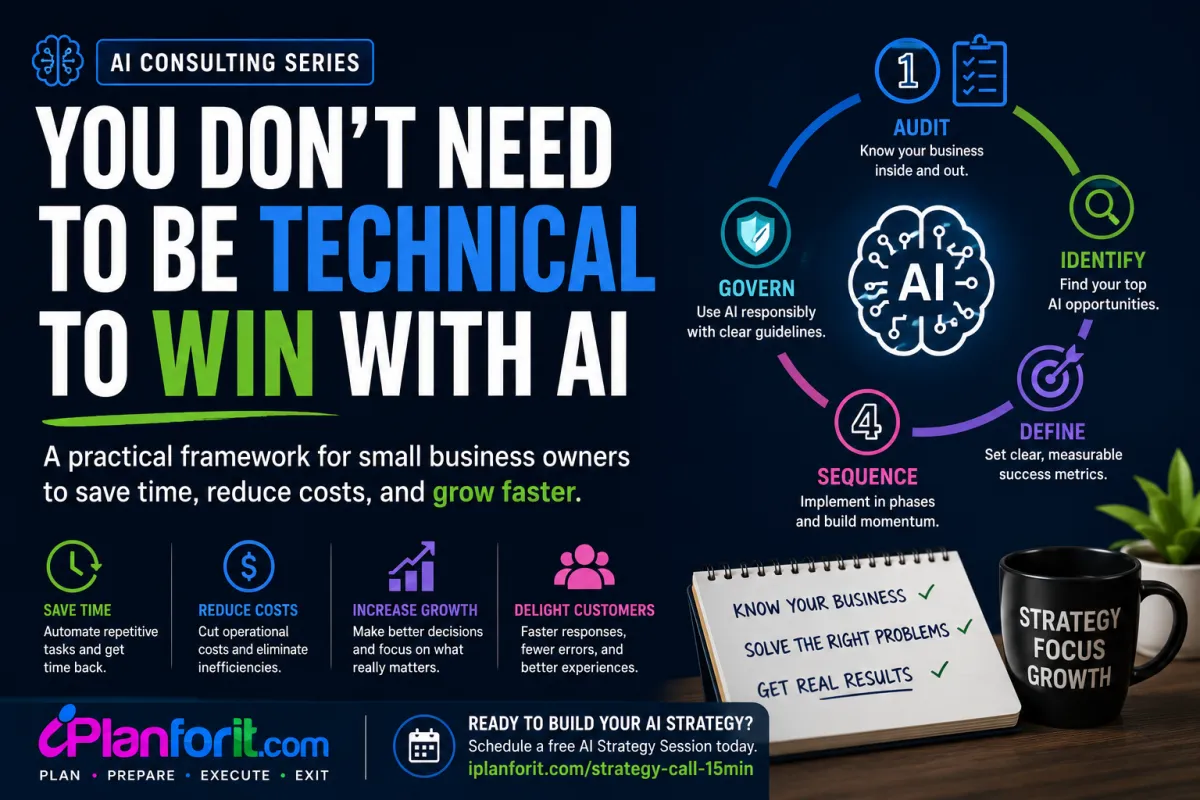
The "Non-Techie" Guide to Automating Your Business
AI Consulting Series
How to Build an AI Strategy for Your Business Without a Tech Background
Most small business owners think AI is a technology problem.
It isn't.
The businesses seeing the biggest returns from AI are not necessarily the most technical. They are the ones who understand their operations, identify bottlenecks, and solve the right problems first.
You do not need a computer science degree. You do not need a team of data scientists. You do not need a Fortune 500 budget.
What you need is a clear understanding of your business, your biggest challenges, and a practical framework for deciding where AI can create the most value.
This guide will show you how to build an AI strategy that works, regardless of your technical background.
What an AI Strategy Actually Is (And Isn't)
An AI strategy is not a list of tools to buy.
It is not a technology roadmap filled with technical jargon.
It is not a 40-page document that sits on a shelf gathering dust.
A practical AI strategy is simply a prioritized plan for where AI can improve your business and the order in which you will implement it.
It answers three questions:
• What problems are most worth solving?
• What would solving them make possible?
• What is the right sequence to tackle them in?
That is it.
Everything else is execution.
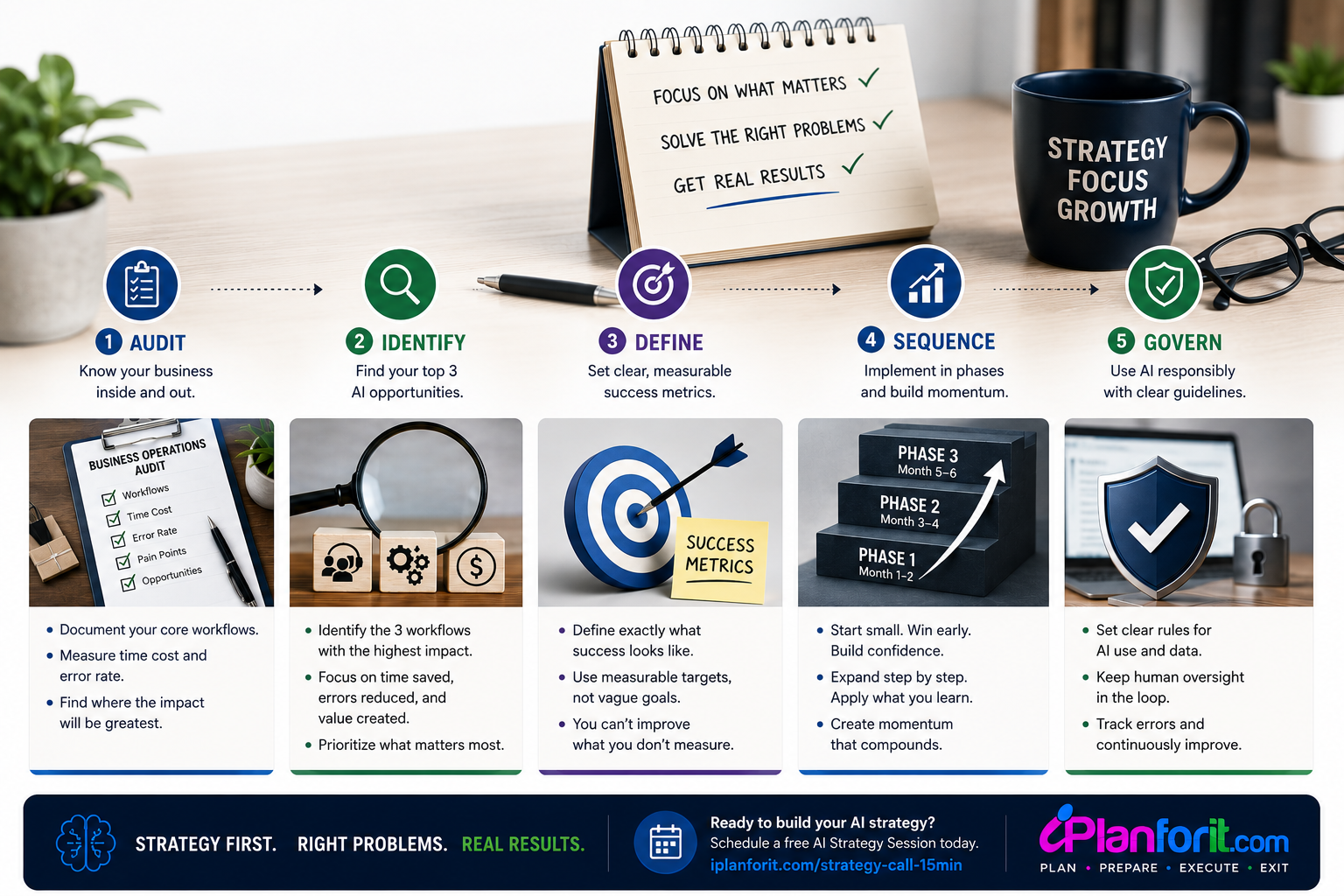
Step 1: Conduct a Business Operations Audit
Before implementing AI, you need a clear picture of how your business operates today.
Start by documenting your core workflows, the recurring processes that keep your business running.
Evaluate each workflow using two measurements:
• Time Cost: How many hours per week does this process consume?
• Error Rate: How often does it create mistakes, delays, or rework?
High time cost + high error rate = your highest-priority AI opportunity. These are the workflows where automation delivers the fastest and most measurable return.
Step 2: Identify Your Top Three AI Opportunities
Once your audit is complete, identify the three workflows with the highest opportunity scores.
These become your first AI priorities.
Real-World Example: Retail
Imagine a boutique clothing shop. The owner spends 8 hours a week manually answering basic customer emails about shipping updates and returns. Sometimes, emails get missed, or details are mistyped. This workflow has a high time cost and a high error rate. This is the perfect opportunity to deploy a simple AI customer service assistant.
For most small businesses, the top three opportunities fall into predictable categories: customer communication, administrative tasks, or financial processes. But every business is different; your audit will surface your specific priorities.
For each priority, ask yourself: If this were handled automatically and accurately, what would change in my business? The answer reveals the true value of solving it.
Real-World Example: Manufacturing
A manufacturing company spends ten hours each week manually creating production reports.
An AI-powered reporting system can automatically generate those reports in minutes, reducing delays, improving visibility, and allowing managers to focus on operations rather than paperwork.
For most businesses, the highest-value opportunities typically fall into one of three categories:
• Customer Communication
• Administrative Tasks
• Financial Processes
For each opportunity, ask yourself:
If this process were handled automatically and accurately, what would change in my business?
The answer reveals the true value of solving it.
Step 3: Define Success Before You Start
One of the most common reasons AI implementations fail is that success was never defined upfront. Before implementing anything, write down exactly what a successful outcome looks like in measurable terms.
Examples include:
• Invoicing: "Reduce time spent on invoicing from six hours per week to under one hour."
• Customer Support: "Handle 60% of inbound customer inquiries without human involvement."
• Reporting: "Reduce report generation time from four hours to 30 minutes."
Vague goals create vague results.
Specific goals create measurable outcomes.
Step 4: Sequence Your Implementation
Many business owners try to automate everything at once.
That approach usually creates confusion and frustration.
A better strategy is to implement AI in phases.
Phase 1 (Months 1–2)
Focus on your single highest-return opportunity (ROI).
Build confidence. Measure results. Learn what works.
Phase 2 (Months 3–4)
Expand into your second priority.
Apply lessons learned from Phase 1.
Phase 3 (Months 5–6)
Implement your third priority and begin connecting systems where appropriate.
By the end of six months, most businesses can have a functioning AI operation delivering measurable results without overwhelming their team.
The AI Strategy Formula
Business Knowledge + Process Documentation + AI Tools + Human Oversight = Sustainable AI Success
Technology alone does not create results.
Strategy does.
Step 5: Build Your AI Governance Framework
The word "governance" sounds complicated, but it simply means establishing rules for how AI will be used within your business.
A basic framework might look like this:
Our Company AI Rules
1. Human in the Loop
A team member must review and approve all AI-generated client-facing content before it is used.
2. Data Boundaries
Sensitive customer information, passwords, and confidential financial data should never be entered into public AI tools.
3. Error Tracking
When AI makes a mistake, document it and improve the process to reduce future errors.
Taking 30 minutes to establish these guidelines today can prevent expensive mistakes tomorrow.
Ask yourself:
• Who approves AI outputs?
• What data can AI access?
• How are errors identified and corrected?
Businesses that answer these questions early avoid many of the problems that make headlines.
Final Thoughts
The businesses winning with AI in 2026 are not the ones chasing every new tool.
They are the ones solving the right problems in the right order.
Start with one workflow.
Measure the result.
Build momentum.
AI success is not about technology.
It is about strategy.
Ready to Build Your AI Strategy?
You do not have to do this alone. Schedule a free AI Strategy Session with iplanforit, Inc., no tech background required.
iplanforit.com/strategy-call-15min
Don Miller
iPlanforit, Inc.
Don Miller | iplanforit, Inc. | AI Consulting for Small and Mid-Sized Businesses

Driving Growth, Amplifying Impact

Unleash Your Business Brilliance.
I help serious business owners and organizations generate more clients, close more sales, and increase their overall revenue and profits quickly and inexpensively