



See Our Latest Posts and News
Access our FREE Blog and Learning Library of content
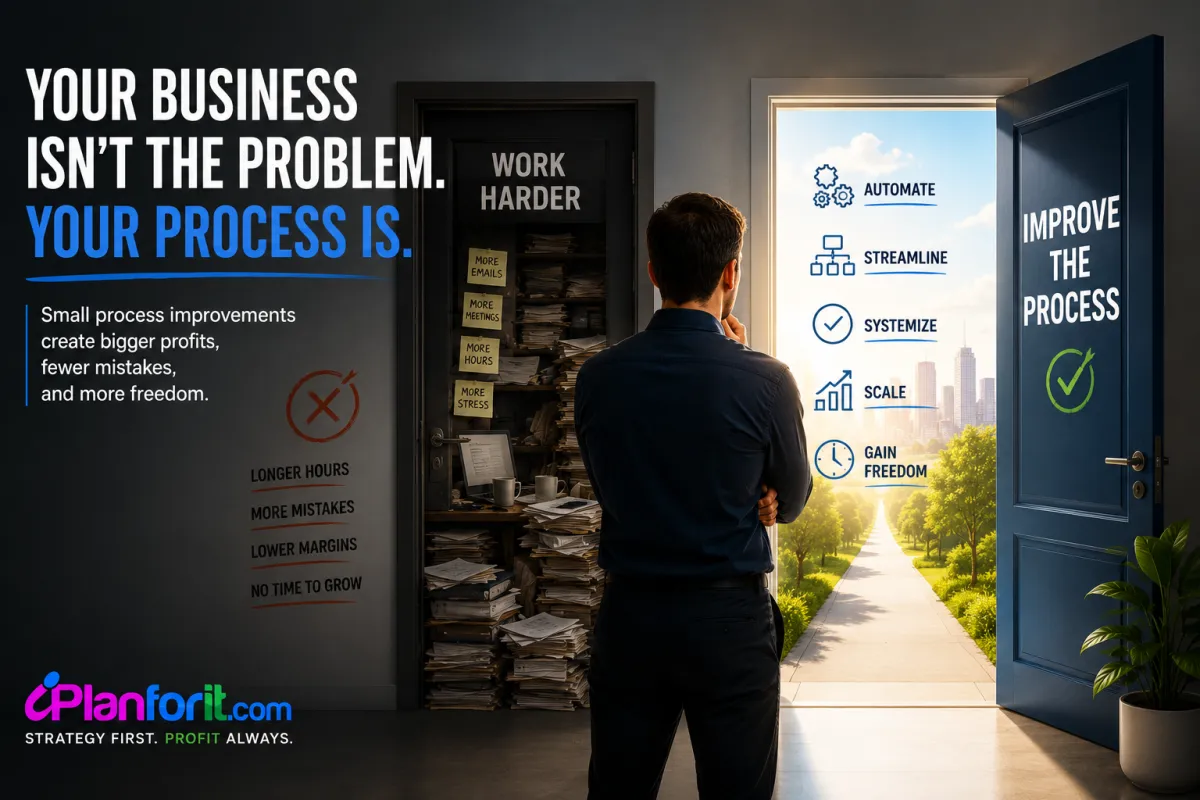
Stop Working IN Your Business: The Simple Guide to Fixing Broken Workflows
OPERATIONS & EFFICIENCY
Business Process Improvement: What It Is and How to Start
Business process improvement sounds corporate and complex. It isn't. Here's what it
really means for a small business and how to get started today.
'Business process improvement' is one of those phrases that sounds like it belongs in a large
corporation, not a small business. But every business, of any size, has processes. And every
process can be improved. In simple terms, business process improvement (BPI) means finding better ways to do what you already do faster, cheaper, with fewer mistakes, and with less effort. It's not about overhauling everything overnight. It's about making consistent, smart improvements over time.
What Is a Business Process?
A business process is any repeatable sequence of steps used to accomplish a business goal.
Common examples include:
• Onboarding a new client
Fulfilling a product order
Resolving a customer complaint
Generating and sending invoices
Training new hires
Following up on marketing leads
Any of these can be executed better. Business process improvement is the discipline of making that happen systematically.
Why Does It Matter for Small Businesses?
For large businesses, inefficiency is expensive but survivable. For small businesses, inefficiency can
be the difference between profit and loss or between growth and stagnation.
• Poor processes lead to careless mistakes and unhappy clients.
• Inefficient workflows waste time that could be spent on growth
• Inconsistent processes mean the quality of your output depends entirely on who is doing the work.
• Unclear processes keep the business owner trapped in day-to-day operations rather than leading.
• Scaling becomes impossible without solid, repeatable foundations.
Case Study: From Chaos to Seamless Scale
Let's look at how fixing just one process can transform a business. We recently worked with a fast-growing digital marketing agency that was drowning in its own success.
The Before: When a new client signed a contract, onboarding was total chaos. The founder had to manually email welcome packages, create shared folders, set up project boards, and schedule kickoff calls. It took 5 hours of manual work per client. Steps were frequently forgotten. Invoices went missing. Clients felt ignored during their first week, leading to early complaints and loss of trust.
The After: We mapped out the steps and built a simple automation system using Zapier, Asana, and Formtool. Now, the moment a client signs their contract, the system automatically sends the welcome email, builds the project board, creates the folders, and texts the client a booking link.
The Result: Onboarding time dropped from 5 hours to 0 minutes for the founder. Zero steps are missed. Client satisfaction soared, and the agency scaled from 5 clients to 25 without adding any administrative staff.
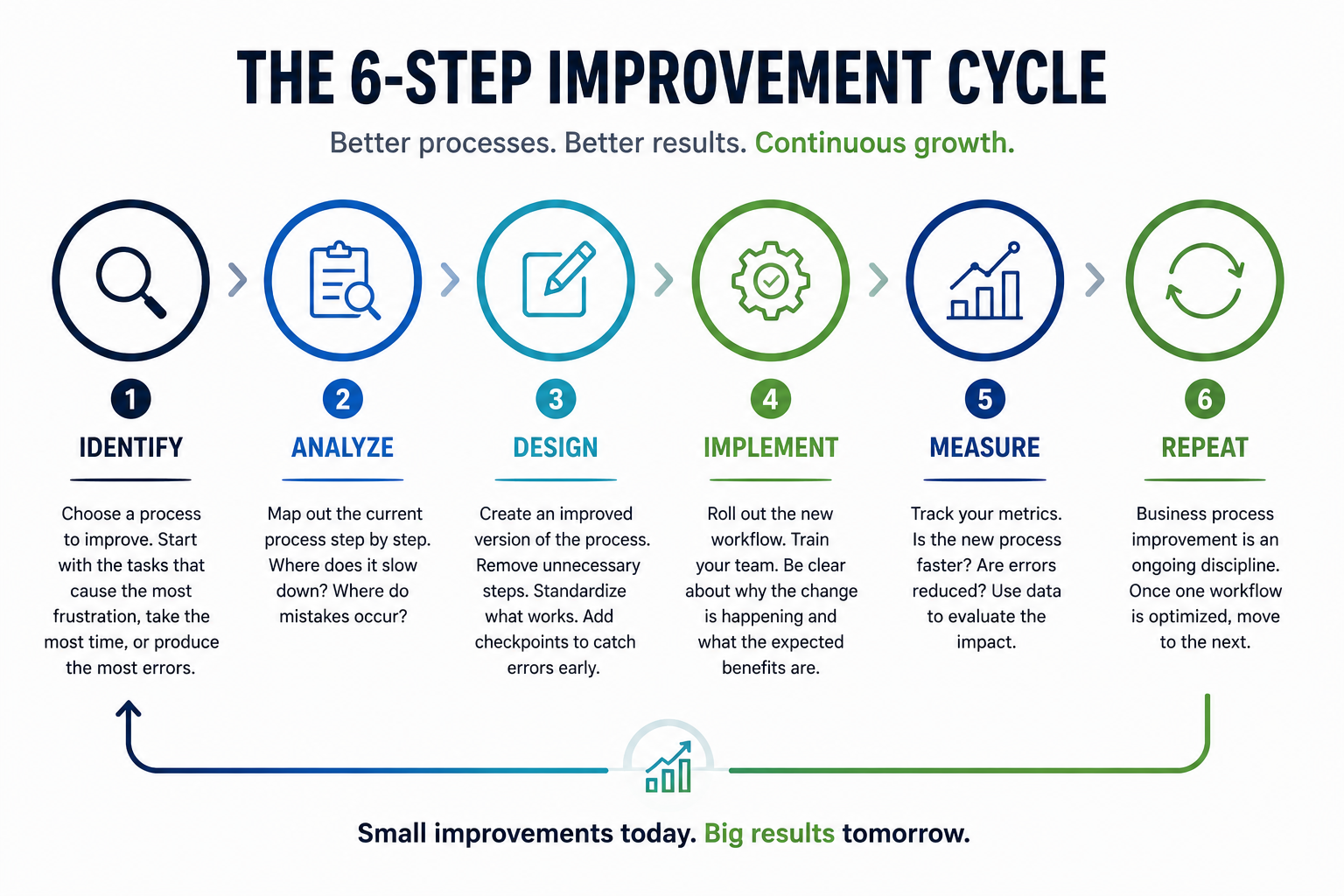
The 6-Step Improvement Cycle:
1. Identify
Choose a process to improve. Start with the tasks that cause the most frustration, take the most time, or produce the most errors.
2. Analyze
Map out the current process step by step. Where does it slow down? Map out the current process step-by-step. Where do things slow down? Where do mistakes occur?
3. Design
Create an improved version of the process. Remove unnecessary steps. Standardize what works.
Add checkpoints to catch errors early.
4. Implement
Roll out the new workflow. Train your team. Be clear about why the change is happening and what the expected benefits are.
5. Measure
Track your metrics. Is the new process faster? Are errors reduced? Use data to evaluate the impact.
6. Repeat
Business process improvement is an ongoing discipline. Once one workflow is optimized, move to the next. This is the competitive advantage of operationally excellent businesses.
The Best Processes to Upgrade First
Don't try to fix everything at once. Target these areas first:
The bottleneck your clients complain about most
The manual task that consumes most of your personal time
The step most likely to cause rework
The system currently blocking your ability to scale
Tools to Streamline Your Operations
You do not need an expensive consultant or an exhaustive corporate methodology to get started. You just need honesty about what is broken and a commitment to iterate. These tools can help modernize your operations:
• Process mapping: Lucidchart, Miro, or even a whiteboard
• Project management: Asana, Monday.com, or Trello
• Automation: Zapier
• Documentation (SOPs): Notion, Google Docs, or Trainual for SOPs
• Time tracking: Toggl or Clockify to identify where time is actually going
The Bottom Line
If you only remember three things from this article, make it these:
Inefficiency is a silent business killer. In big companies, it costs money. In small businesses, it stops you from growing and locks you in daily grunt work.
Start small to win big. Do not try to fix everything at once. Pick the single most annoying, time-sucking task in your week and fix that first.
Tech alone won't save you. Tools like Zapier or Asana only work if you map out a clean, simple process on paper first.
Want to identify and fix the processes slowing your business down?
Consistency creates scalability. If you want to run leaner, smarter, and more profitably, let’s talk. Book a Free Discovery Call with Us Today 🔗iplanforit.com/strategy-call-15min


Driving Growth, Amplifying Impact

Unleash Your Business Brilliance.
I help serious business owners and organizations generate more clients, close more sales, and increase their overall revenue and profits quickly and inexpensively