



See Our Latest Posts and News
Access our FREE Blog and Learning Library of content

Build It to Sell It: Why Most Small Businesses Are Unsellable
Small Business Exit Planning
The $14 Trillion Blindspot: Why Your Small Business Is Unsellable
(And How to Fix It)
You don’t need to run a Fortune 500 company to need an exit strategy. In fact, if you’re like most small business owners, your business is your largest, most illiquid asset.
Yet, research reveals a staggering blind spot: nearly half of all small business owners have absolutely no written exit plan. With a generational wealth transfer underway, billions in enterprise value are at risk of being lost.
The fundamentals of a successful exit are the same whether your business generates $500K or $50M. The difference between a lucrative payday and a walk-away by buyers comes down to four cornerstones: preparation, valuation, transferability, and the right advisory team.
The 3 Silent Value Killers
Before going to market, you must understand the unique dynamics of selling a small business (revenues under $10M). The market can be brutal if you ignore these three realities:
Owner Dependency: The #1 value killer. If the business cannot run without you (e.g., you are the primary salesperson, relationship holder, and chief decision-maker), buyers will heavily discount the price or walk away entirely.
Limited Buyer Financing: Most buyers rely on SBA 7(a) loans. Lenders will scrutinize your financials just as severely as the buyer does. Clean, demonstrable cash flow is non-negotiable.
The Valuation Disconnect: Business owners routinely overvalue their companies by 30% to 50% because they price in their emotional investment, not objective financial metrics.
The 7-Step Unfair Advantage Exit Roadmap
Building an extraordinary exit takes time, but following these steps can dramatically transform both your business and your life.
Step 1 — Define Your Goals (Today)
What do you need financially? What legacy matters to you? When do you want to exit? Write it down immediately. Vague goals produce vague outcomes.
Step 2 — Get Valued (Year 1)
Commission a professional valuation. Understand exactly what drives and diminishes your value, and identify the gap between today’s value and your financial target.
Step 3 — Clean Up Operations (Years 1–2)
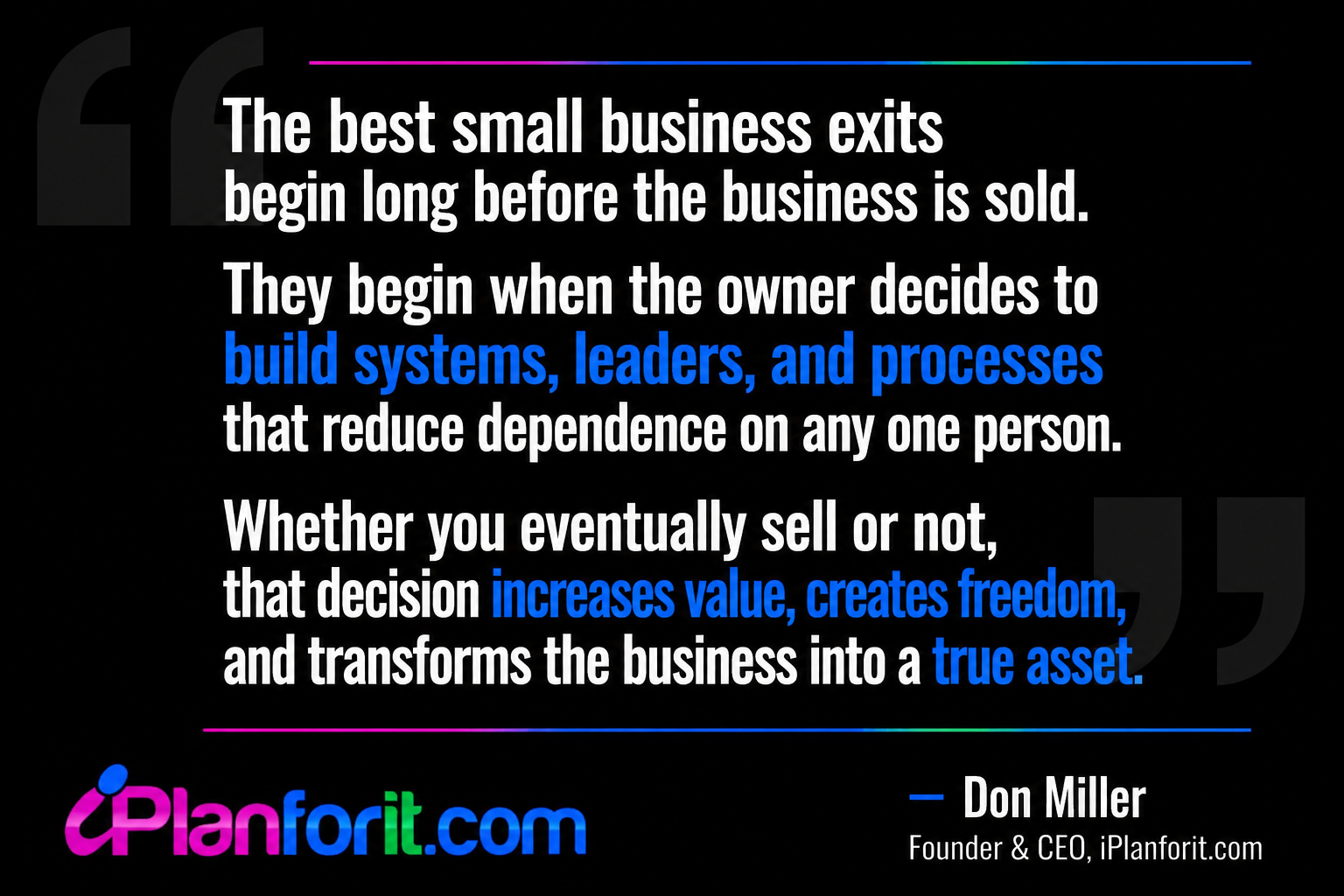
Build a management layer so your daily presence is no longer required. Document Standard Operating Procedures (SOPs) for every critical process, and systemize your lead generation.
Step 4 — Organize Your Financials (Years 1–2)
Work with a CPA to produce clean, organized financials. Address bookkeeping anomalies, normalize owner compensation, and remove personal expenses from the P&L.
Step 5 — Build Your Advisory Team (Year 2)
Do not wait until you are ready to sell. Engage an exit-experienced CPA, attorney, and M&A advisor early on to structure your tax strategy and legal entities.
Step 6 — Optimize Value Drivers (Years 2–4)
Increase margins, protect your intellectual property, and convert transactional clients into recurring contracts. Reduce customer concentration so no single client accounts for more than 10% of revenue.
Step 7 — Go to Market (Year 3+)
Once prepared, work with your broker to market confidentially, qualify buyers, and expertly navigate the due diligence process.
Why You Need a Consultant Long Before a Broker
Many owners make the mistake of running straight to a broker when they want to sell. But brokers market what you have today; they do not fix your operational leaks or build your management layer.
For businesses under $5M, you want a trusted business consultant to quarterback the preparation phase. A consultant optimizes your value drivers so you can command a premium price. Once your business is running without you, your consultant will help you transition to the right transaction team.
When you are finally ready to go to market, look for brokers who:
Hold a Certified Business Intermediary (CBI) designation from the International Business Brokers Association.
Specialize heavily in your specific industry.
Maintain strict confidentiality protocols to protect your staff and clients.
Pro-Tip: Work with your consultant to interview at least three brokers before signing any agreement.
Your small business represents years of sacrifice, creativity, and perseverance. It deserves an exit that honors that investment personally and financially. Start planning now, build with the end in mind, and give yourself the runway to create an exit you’ll be proud of.
Stop Guessing Your Business’s Value. Start Building Your Exit.
Don’t leave your years of hard work to chance. If you want to fix your value killers, step away from daily operations, and command a premium price when you sell, let’s talk.
Claim Your Free Exit Strategy Consultation 🔗iplanforit.com/strategy-call-15min
© 2026 Exit Strategy Experts. For informational purposes only. Consult qualified legal, financial, and tax advisors before making any exit planning decisions.

Driving Growth, Amplifying Impact

Unleash Your Business Brilliance.
I help serious business owners and organizations generate more clients, close more sales, and increase their overall revenue and profits quickly and inexpensively