



See Our Latest Posts and News
Access our FREE Blog and Learning Library of content
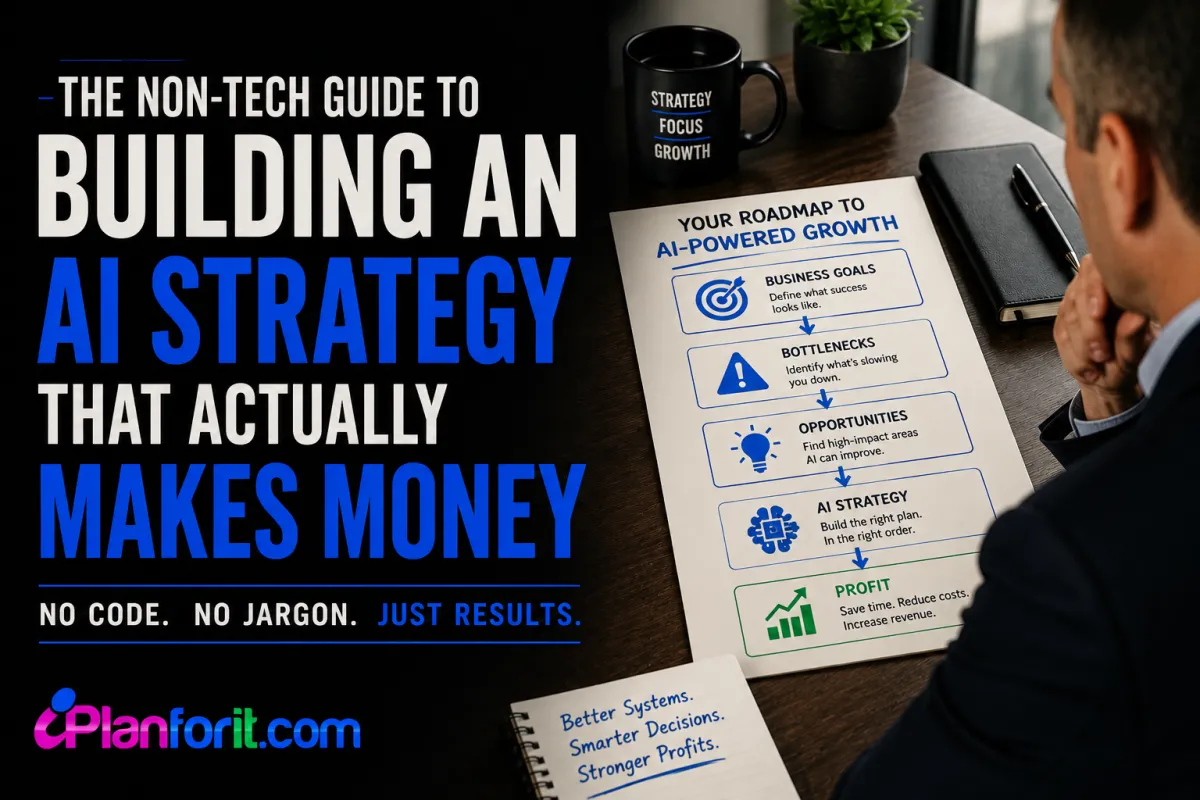
How to Build an AI Strategy for Your Business Without a Tech Background
AI Consulting Series
The Non-Tech Guide to Building an AI Strategy That Actually Makes Money
The phrase "AI strategy" sounds like it belongs in a Fortune 500 boardroom. It doesn't.
In 2026, building an AI strategy for your small business is not about coding. It is about knowing your business bottlenecks better than anyone else. You do not need to understand machine learning. You just need to know your goals, your pain points, and how to sequence change.
This simple framework will help you build a high-ROI AI strategy without a single line of code.
You don't need to understand machine learning to build an effective AI strategy. You need to understand your business goals, your biggest pain points, and how to think clearly about change. This post gives you a framework that works regardless of your technical background.
What an AI Strategy Actually Is (And Isn't)
An AI strategy is not a random list of software tools to buy. It is not a 40-page deck full of technical jargon.
A practical AI strategy is a prioritized roadmap for where automation can deliver the greatest competitive advantage. It answers three questions:
What problems are most worth solving?
What would solving them make possible?
What is the right sequence to tackle them in?
That's it. Everything else is execution.
The 5-Step Blueprint for Non-Technical Owners
Step 1: Conduct a Business Operations Audit
Before any AI strategy can be built, you need a clear picture of how your business actually operates today. This means documenting your core workflows, the repeated processes that keep your business running, and evaluating each on two dimensions:
• Time cost: How many hours per week does this workflow consume?
• Error rate: How often does this workflow produce mistakes or require rework?
High time cost + high error rate = your highest-priority AI opportunity. These are the workflows where automation delivers the fastest and most measurable return.
Step 2: Identify Your Top 3 AI Opportunities
Look for tasks in customer service, admin, or finance. In 2026, businesses are shifting from simple chatbots to autonomous AI agents capable of handling multi-step workflows. Target three specific areas for your first phase.
For most small businesses, the top three opportunities fall into predictable categories: customer communication, administrative tasks, or financial processes. But every business is different; your audit will surface your specific priorities.
For each priority, ask: If this were handled automatically and accurately, what would change in my business? The answer reveals the true value of solving it.
Step 3: Define Success Before You Start
One of the most common reasons AI implementations fail is that success was never defined upfront.
Before implementing anything, write down exactly what a successful outcome looks like in measurable terms.
• "Reduce time spent on invoicing from 6 hours/week to under 1 hour/week."
• "Handle 60% of inbound customer inquiries without human involvement."
• "Reduce report generation time from 4 hours to 30 minutes."
Vague goals produce vague results. Specific targets give you something to measure and something to celebrate when you hit them.
Step 4: Sequence Your Implementation
Not everything should be tackled at once. A practical AI implementation sequence for small businesses follows this logic:
• Phase 1 (Month 1–2): Tackle the single highest-ROI opportunity. Build confidence, demonstrate results, and refine your process.
• Phase 2 (Month 3–4): Expand to the second priority. Apply what you learned in Phase 1.
• Phase 3 (Month 5–6): Add the third priority and begin looking at how your AI tools can work together.
By month six, most small businesses have a functioning, measurable AI operation built incrementally, without overwhelm.
Step 5: Build Your AI Governance Framework.
You must set boundaries. Take 30 minutes to write down your AI house rules:
Human-in-the-Loop: Who reviews the AI's work before it goes to a client?
Data Privacy: Are you keeping sensitive financial data out of public AI models?
Error Catching: What is the exact process when the AI makes a mistake?
Businesses that take 30 minutes to define these rules upfront avoid the kinds of AI mistakes that make the news.
Stop Guessing Your AI Strategy. Start Scaling Your Business.
Don't waste time and money on overhyped tools that don't move the needle. Build a tailored, secure AI roadmap that actually drives profit.
Claim Your Free AI Strategy Consultation ]🔗iplanforit.com/strategy-call-15min
Don Miller | iplanforit, Inc. | AI Consulting for Small and Mid-Sized Businesses

Driving Growth, Amplifying Impact

Unleash Your Business Brilliance.
I help serious business owners and organizations generate more clients, close more sales, and increase their overall revenue and profits quickly and inexpensively