



See Our Latest Posts and News
Access our FREE Articles and Learning Library of content

The Restaurant Owner's Guide to Hidden Profit
Business, Local Marketing, Profitability
Lessons From a Lifetime in Business
The Restaurant Owner's Guide to Hidden Profit
The 12 Profit Accelerators That Separate Thriving Restaurants from Those That Simply Survive
Most restaurant owners don't have a revenue problem.
They have a profit problem.
More specifically, they have a dozen small profit leaks quietly draining money from their business every single day.
The good news? You don't need a miracle. You need a better strategy.
One of the biggest misconceptions I see is that struggling restaurants simply need more customers. While new customers certainly help, I've learned that the fastest path to higher profit usually isn't filling more tables. It's getting more value from the customers, systems, and opportunities you already have.
Working with business owners across many industries, we consistently find that restaurants present one of the greatest opportunities for operational improvement. Why? Because restaurants are incredibly complex businesses. Every day you're managing inventory, labor, food costs, marketing, customer experience, pricing, vendors, technology, and cash flow, all while trying to deliver an exceptional dining experience.
The restaurants that consistently outperform their competition aren't always the ones serving the best food.
They're the ones operating the best business.
That's why the proprietary software behind our work, the Restaurant Profit Accelerator 12™, is built around a simple idea: there are twelve specific areas inside every restaurant where small improvements create extraordinary financial results.
Why Small Improvements Create Big Results
Most owners look for one breakthrough. A better marketing campaign. A viral social media post. A new menu. A second location.
In my experience, sustainable profit rarely comes from one dramatic change. It comes from making dozens of smart decisions that work together.
Think about it this way. If you improve twelve critical areas of your restaurant by only 3% each, the combined financial impact isn't 36%.
It compounds.
I've seen restaurants uncover well over $150,000 in additional annual profit simply by making disciplined improvements across multiple areas rather than chasing one silver bullet. The same principle held true for a service-based small business I worked with in a completely different industry: modest, deliberate improvements across a dozen areas, not one clever idea, produced the financial breakthrough. The framework isn't restaurant-specific. Restaurants just happen to have more leaks than most businesses to find it in.
That's the power of compounding. Small strategic improvements become extraordinary financial results.
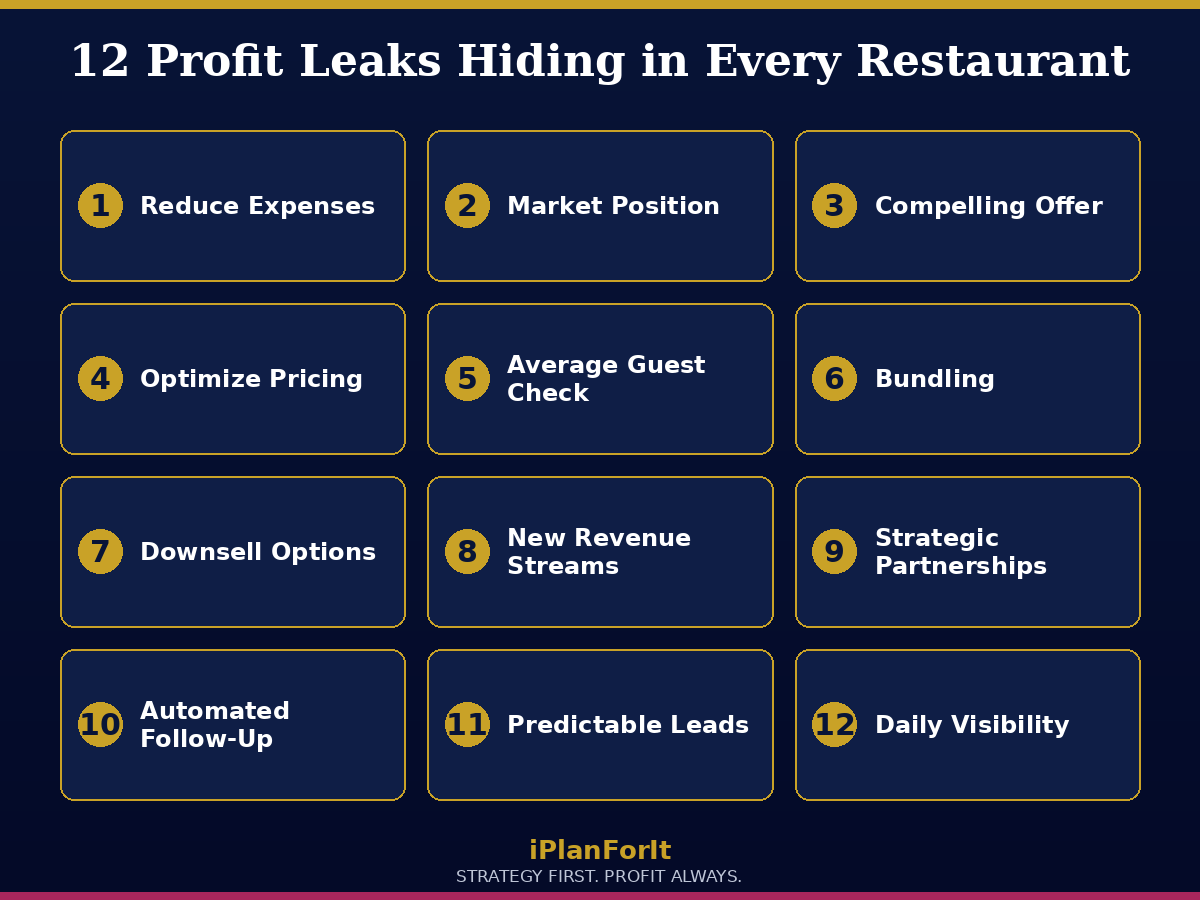
The Restaurant Profit Accelerator 12™
These are the twelve areas we evaluate whenever we begin working with a restaurant owner.
1. Reduce Expenses Without Sacrificing Quality
Every dollar you save goes directly to your bottom line.
Food waste. Over-ordering. Unused subscriptions. Poor scheduling. Duplicate vendors.
These aren't isolated expenses. Together they quietly consume thousands of dollars every month. I begin every engagement by identifying where money is leaking before asking how to make more of it.
2. Build a Market-Dominating Position
"Great food." "Excellent service." Those aren't differentiators. They're expectations.
The restaurants that dominate own one idea in customers' minds. Perhaps they're known as the city's best brunch. The fastest executive lunch. The finest farm-to-table experience. The most family-friendly dining destination.
If customers can't explain why you're different in one sentence, neither can your marketing.
3. Create an Offer People Can't Ignore
Most restaurants simply ask people to visit. The most profitable restaurants give people a reason to visit today.
Exclusive tasting nights. Chef experiences. Birthday clubs. Seasonal events. First-visit incentives.
A compelling offer increases traffic without relying solely on advertising.
4. Optimize Pricing Strategically
Many owners underprice out of fear. Pricing should be driven by value, market position, and profitability, not emotion.
Often, a carefully planned adjustment on your best-selling items increases profit significantly while having little effect on demand.
Pricing is strategy. Not guesswork.
5. Increase the Average Guest Check
The easiest customer to sell to is the one already sitting at your table.
Desserts. Specialty drinks. Premium upgrades. Appetizers. Thoughtful recommendations increase guest satisfaction while increasing average ticket value.
Everyone wins.
6. Bundle for Higher Profit
People enjoy making easier decisions.
Date-night packages. Family meals. Wine pairings. Chef's selections.
Bundles increase perceived value while improving margins.
7. Capture Guests You Would Otherwise Lose
Not every customer wants your premium experience every time.
Express lunches. Happy hour. Smaller portions. Early dining specials.
Serving different budgets helps keep customers inside your brand rather than losing them to competitors.
8. Build Additional Revenue Streams
Your dining room shouldn't be your only source of revenue.
Catering. Cooking classes. Retail sauces. Meal subscriptions. Corporate events. Gift cards.
Every successful restaurant should continually ask: what else can we sell to customers who already love us?
9. Create Strategic Partnerships
One of the fastest ways to grow is by borrowing someone else's audience.
Hotels. Wedding venues. Breweries. Corporate offices. Tourism organizations. Health clubs.
Strategic partnerships often outperform expensive advertising campaigns.
10. Build Automated Guest Relationships
Too many restaurants rely entirely on memory. Successful restaurants build systems.
Birthday campaigns. Reservation reminders. Anniversary offers. Win-back campaigns. Loyalty rewards.
Automation turns one-time guests into long-term customers.
11. Create a Predictable Flow of New Guests
The best restaurants don't hope customers show up. They build consistent lead-generation systems.
Google. Reviews. Social media. Referral programs. Local partnerships. Community involvement.
Predictable marketing creates predictable revenue.
12. Stay Visible Every Day
Your competitors aren't just competing for customers. They're competing for attention.
Behind-the-scenes videos. Chef stories. Customer testimonials. Short-form video. Community events.
The restaurants people remember are the restaurants they regularly see.
What I Would Focus on First
If I had only thirty days to improve a restaurant's profitability, I'd focus on four priorities:
Reduce waste and improve menu profitability.
Increase average guest spend through pricing, bundling, and upselling.
Improve guest retention through automated follow-up.
Build a stronger market position that competitors can't easily copy.
Those four areas alone often create measurable financial improvement within weeks.
My Perspective
After helping many business owners improve profitability, I've learned something that surprises many restaurant owners.
The businesses that consistently outperform their competitors rarely work harder. They think differently. They understand their numbers. They build better systems. They make hundreds of small strategic decisions that compound over time.
Most importantly, they stop asking "how do we get more customers" and start asking "how do we create more value from the customers and business we already have?"
That's where hidden profit lives. And that's where I begin every strategy session.
Ready to Discover Where Your Restaurant Is Leaving Money on the Table?
Every restaurant is different. Some lose profit through labor. Others through menu engineering. Others through pricing, operations, marketing, or technology.
A short strategy session is often enough to identify which of these twelve areas is costing you the most, in real dollars, this year, and which one, fixed first, would move your numbers fastest.
You may discover that your next six figures of profit aren't waiting for more customers.
They've been hiding inside your business all along.
If you're ready to find out where your restaurant's hidden profit is waiting, book a free 15-minute strategy call. No pitch, no pressure, just a clear look at which of these twelve areas is costing you the most right now, and what fixing it first would be worth to you.
🔗iplanforit.com/strategy-call-15min
Don Miller ~ Founder & CEO ~ iPlanForIt.com


Driving Growth, Amplifying Impact

Unleash Your Business Brilliance.
I believe every business has untapped potential.
My mission is to help business owners uncover it, accelerate growth, increase profitability, and build more valuable, scalable, and future-ready companies.