



See Our Latest Posts and News
Access our FREE Articles and Learning Library of content
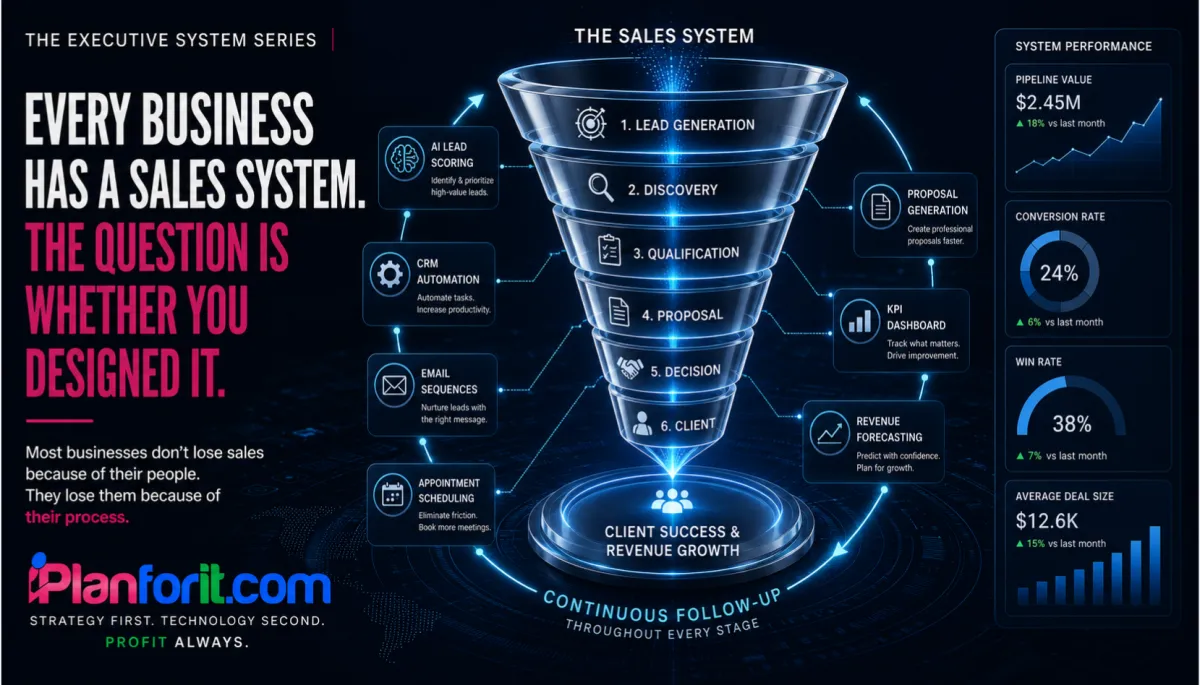
Every Business Has a Sales System. The Question Is Whether You Designed It.
Sales Strategy, Revenue Growth
Why Your Sales System Matters More Than Your Sales Team
When sales slow down, most business owners have the same reaction.
We need more leads. We need more marketing.
Or we need to hire another salesperson.
Sometimes that's true.
But after more than forty years of consulting with businesses across dozens of industries, I've found that the real problem is rarely the number of leads.
It's everything that happens after the lead arrives.
Missed quotas. Slipping win rates. An unpredictable pipeline that nobody can fully explain. The instinctive response is to push harder. More calls. More emails. More pressure. More activity.
Yet even after a burst of effort, results barely move.
That's because effort cannot consistently overcome a weak or inconsistent sales system.
And confusing a system problem for a people problem is one of the most expensive mistakes a business owner can make.
What a Sales System Problem Actually Looks Like From the Inside
Here's the uncomfortable truth most business owners don't want to hear.
If your salespeople are chasing poorly qualified leads, delivering inconsistent messages to similar prospects, skipping key discovery or follow-up steps, and reacting to deals instead of guiding them through a clear process, you don't have a motivation problem.
You have a process problem.
Inconsistent inputs produce inconsistent outcomes. Every time. No matter how talented your people are.
And the most revealing sign of a system problem isn't a missed quota.
It's this: when your best salesperson leaves, your sales fall apart.
That tells you everything. Because in a business with a real sales system, no single person's departure collapses the results. The system carries the performance, not the individual.
I've watched business owners lose their top salesperson and spend years trying to find a replacement who performs the same way. All the while, the actual fix was never finding a better person.
It was building a better system.

Every Interaction Is Either Building Confidence or Creating Doubt
Before we talk about fixing the system, there's something more fundamental worth understanding.
Sales doesn't begin when someone asks for a quote.
Sales begins long before that first conversation.
Every advertisement your business runs. Every Google review someone reads. Every time your website is visited, your phone is answered, or your email is replied to or not. Every social media post. Every interaction a prospect has with your business before they ever speak to a salesperson.
All of it is either building confidence in your business or creating quiet doubt about it.
The businesses that consistently outperform their competitors understand that selling isn't a single event.
It's a carefully designed journey.
And the most important question isn't "how do we generate more leads?"
The most important question is "how many opportunities are we already losing that we should be winning?"
In most businesses, the answer to that question is far more significant than most owners realize.
What the Highest-Performing Sales Organizations Do Differently
The highest-performing sales organizations don't close more because they work harder.
They close more because they follow a better system.
Their success is built on structure, not heroics. And when you look closely at how they operate, five consistent patterns emerge.
Every Opportunity Moves Through Clearly Defined Stages
There is no ambiguity about what comes next.
Every prospect moves through an agreed sequence of steps from initial inquiry to closed and won, or disqualified early, with clear criteria defining what moves a deal forward and what signals it should be exited.
When everyone on the team knows exactly what the next step is, momentum replaces confusion. And deals stop dying in the middle of the pipeline where nobody is quite sure who owns them.
Qualification Is Consistent, Not Instinctive
Top sales teams use shared criteria to decide which prospects deserve their time.
Not gut feel. Not relationship intuition. Defined criteria applied consistently across every inquiry.
Are you attracting the right prospects in the first place? Or are your best salespeople spending their most valuable hours chasing people who were never likely to become customers?
The quality of a prospect almost always outperforms the quantity of prospects. The businesses that learn this early stop confusing activity with progress.
Speed Is Treated as a Competitive Advantage
Research consistently shows that responding quickly to new inquiries dramatically increases the likelihood of converting them into a meaningful conversation.
In today's marketplace, customers frequently choose the company that responds first, not necessarily the one with the best product or the lowest price.
Every hour a new lead sits unanswered is an hour your competitor has to make a better first impression.
Speed wins. Consistently. And it costs nothing to improve.
Follow-Up Is a System, Not an Afterthought
Most businesses or salespeople give up after one or two attempts to contact.
The data tells a very different story. The majority of sales require five or more meaningful touchpoints before a prospect makes a decision. Most salespeople never get there, not because they're lazy, but because there's no system holding them accountable to the sequence.
Consistent, professional follow-up demonstrates commitment and builds trust in a way that a single strong first conversation never can.
The revenue hiding in unworked follow-up is one of the most consistent findings I make when I first sit down with a new client.
Trust Is Built Before the Close Is Attempted
People don't like feeling sold.
They like feeling understood.
The best sales professionals ask thoughtful questions, listen carefully, and focus entirely on solving problems rather than delivering presentations.
Trust shortens the sales cycle.
Pressure almost always extends it.
When a prospect feels genuinely understood, when they believe you are solving their problem rather than hitting your number, the close becomes a natural next step rather than a negotiation.
Key Takeaway: Before you ask your team to do more, ask whether your system shows them exactly what to do, when, and why.

How to Know If You Have a System Problem
Before you ask your team to work harder, ask whether your system shows them exactly what to do, when to do it, and why it matters.
Start here. Ask yourself these questions honestly.
Do you have a clearly documented sales process that every team member understands and consistently follows?
Is your CRM configured to support that process, or are your salespeople working around it because it doesn't reflect how deals actually move?
Do your managers coach to the process review stage, covering conversion rates, deal velocity, and pipeline bottlenecks, or do they coach only to the final number?
Are your best discovery questions, objection responses, and proposal frameworks written down, trained on, and consistently used, or does every salesperson reinvent them from scratch and use their own method?
If the honest answer to any of those questions is "no" or "I'm not sure," you have a system gap. And that gap is costing you revenue every single day.
The most useful reframe I can offer: treat your sales process like a product. Design it deliberately. Test it. Gather feedback from the people using it. Improve it continuously. The businesses that do this create a compounding advantage over competitors who continue to rely on individuals to drive performance on their own.
AI Is Strengthening Sales Systems, Not Replacing the People in Them
Artificial intelligence is not replacing sales professionals.
It's giving the best ones more time to do the one thing technology cannot do.
Build relationships.
The next generation of sales systems will not rely on people to remember every follow-up, update every CRM field, or manually score every opportunity. AI now handles many of those repetitive tasks automatically, allowing sales professionals to spend their time where they create the greatest value: building relationships, solving problems, and earning trust. Businesses that integrate AI into well-designed sales systems aren't replacing salespeople. They're eliminating friction, increasing consistency, and making every salesperson more productive.
CASE STUDY: How One Business Added $340,000 in Annual Revenue Without a Single New Salesperson
A regional service business came to me with a sales problem they had been trying to solve for two years.
Revenue had plateaued. The owner had hired two additional salespeople over that period. Both had produced modest results before leaving within eighteen months. He was preparing to hire a third.
Before he did, we spent a session mapping what actually happened to a new lead from the moment it arrived to the moment it became or didn't become a customer.
What we found was striking.
The average response time to a new inquiry was eleven hours. The industry benchmark for conversion was under one hour.
Of the leads who received a proposal, 68% received no follow-up after it was sent. The sales team assumed that if a prospect was interested, they would call back.
There was no defined qualification process. Salespeople were spending equal time on leads that converted at 40% and on leads that converted at less than 4%, with no system for distinguishing between them.
And there was no sales process document. Every salesperson approached discovery, presentation, and close differently. Results varied enormously depending on who handled the inquiry.
We made four changes over sixty days.
Response time was reduced to under thirty minutes through a combination of process change and simple automation.
A five-touch follow-up sequence was built and made mandatory for every proposal sent.
A qualification scorecard was created so every salesperson could identify high-probability leads within the first conversation.
A documented sales process was built, trained on, and reviewed in every weekly sales meeting.
No new salesperson was hired.
At the end of the following twelve months, revenue had increased by $340,000.
The same team. The same market. The same product.
A completely different system.

My Perspective
The businesses with the strongest sales results are rarely the ones with the best products.
They're the ones with the best systems.
I've believed that for forty years, and everything I've seen in that time has only confirmed it.
Sales should never depend on a single extraordinary salesperson, whose departure takes revenue with them. It should be a process that can be taught, measured, improved, and repeated by any capable person who understands it.
There's another thing I've learned that most business owners resist hearing.
The strongest sales organizations don't focus primarily on selling.
They focus on serving. On listening. On solving problems with genuine care for the outcome on the other side of the table.
When every step of the customer journey is intentional, when every touchpoint is designed to build trust rather than apply pressure, conversions become the natural result of a well-built relationship.
Not the forced outcome of a close, well-executed.
That's the shift. And when a business makes it, something remarkable happens.
Sales stops feeling like a grind.
It starts feeling like what it was always supposed to be.
A conversation between someone with a problem and someone with the ability to solve it.
Build the system that creates more of those conversations.
The revenue follows.
Final Thought
Every business has a sales system. Some are intentionally designed. Others develop by accident.
The businesses that outperform their competitors don't simply hire better salespeople. They build systems that consistently produce better salespeople.
When your process is clear, your messaging is consistent, your follow-up is disciplined, and every customer interaction builds trust, growth becomes predictable instead of accidental.
That's the difference between hoping for better sales and engineering them.
Want to know where your sales system is leaking revenue and exactly what it would take to fix it?
Book a free 30-minute discovery call at iplanforit.com/strategy-call-15min
We'll map your current sales process, identify the specific gaps costing you the most revenue, and build a practical plan to close them.
No obligation. No pressure. Just a clear picture of what's possible when your sales system is built to win.
Don Miller
Founder & CEO, iPlanForIt, Inc.
© 2026 iPlanForIt, Inc. All Rights Reserved | iplanforit.com Don Miller, Founder & CEO
Strategy First. Profit Always.™

Driving Growth, Amplifying Impact

CHOOSE HOW YOU WANT TO WORK WITH US
BUILD A STRONGER, MORE VALUABLE BUSINESS.
We uncover hidden profit opportunities, reduce unnecessary expenses, strengthen operations, implement AI strategically, and help owners build more profitable, valuable, and transferable companies.
Our mission is simple: help business owners turn untapped potential into stronger performance, sustainable growth, and greater long-term enterprise value.