



See Our Latest Posts and News
Access our FREE Articles and Learning Library of content
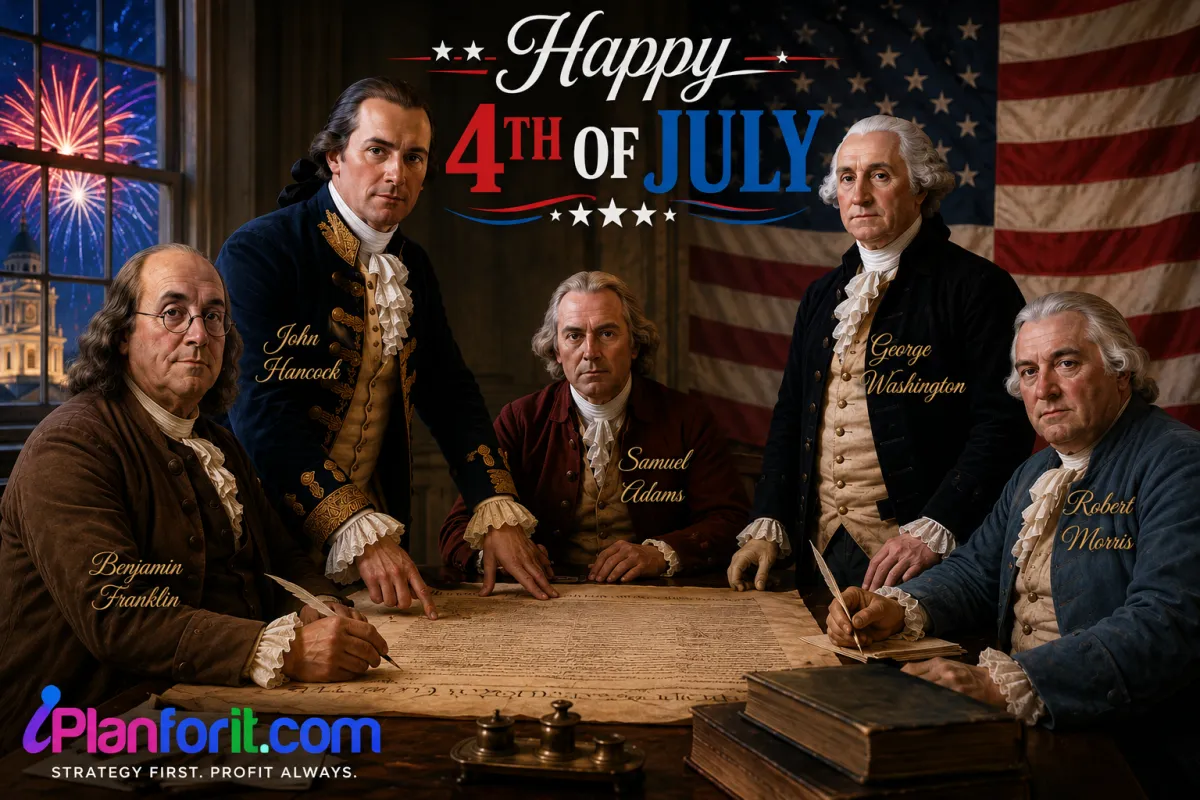
Founding Fathers: Entrepreneurs of Early America
The First Business Owners of America
Strategy First. Profit Always. — Even in 1776.
Every Fourth of July, we celebrate a political revolution. We talk about liberty, tyranny, and the courage it took to sign a document that amounted to treason against the most powerful empire on earth.
What we rarely talk about is that most of the men in that room weren't career politicians. They were business owners. Operators. People who understood risk, cash flow, and what it costs personally to bet everything on something bigger than yourself.
After forty years of sitting across the table from founders, I've come to believe the Declaration of Independence wasn't just a political document. It was the boldest business decision in American history made by men who understood exactly what they were risking, because they'd already built something with their own hands.
Here's what I mean.
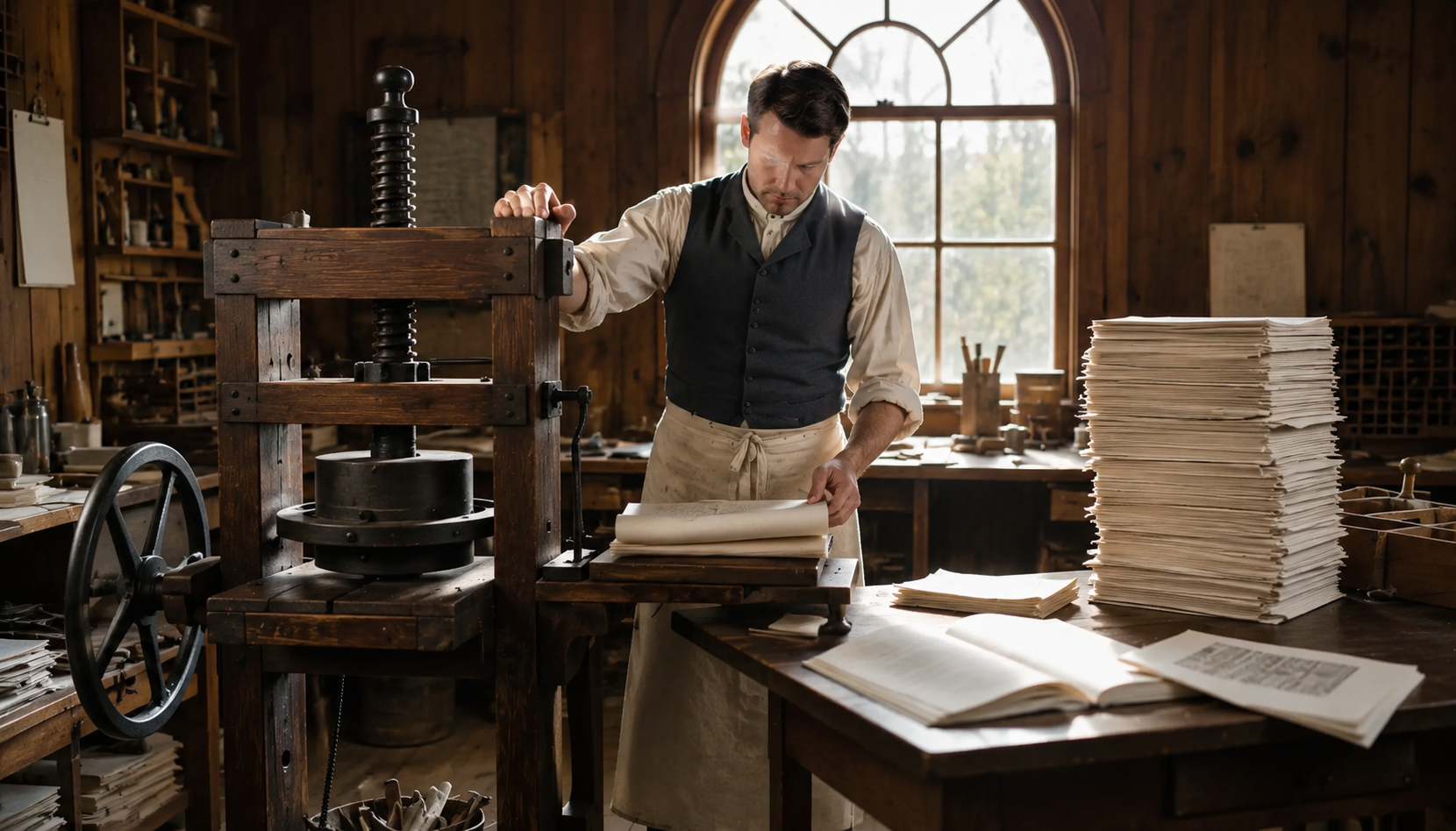
Franklin’s bustling print shop turned ideas into income and influence.
Benjamin Franklin understood distribution before anyone had a word for it
Franklin ran the printing business that put news in the hands of colonists up and down the coast, selling roughly 10,000 copies of Poor Richard's Almanac every single year for a quarter century, mastering marketing before the term even existed, using humor and practicality to keep customers coming back.
But the print shop wasn't his only venture. He owned dozens of rental properties in Philadelphia, franchised his printing operation into other colonies, splitting profits with the operators he trained, and helped organize early insurance and infrastructure projects. He believed in apprenticeships, fair contracts, and reinvesting profits into new ventures habits that mirror today's most resilient small and mid-sized businesses. By his early forties, historians estimate his income at around $300,000 a year in today's dollars.
Franklin didn't get lucky. He built a distribution engine, then he replicated it. If you've ever built a business by figuring out the one channel that actually moves your product and then doubling down on it, you already understand Franklin better than most history books give him credit for.
John Hancock: ran a shipping empire — and signed his name like he meant it
Hancock didn't build his fortune from nothing. He inherited one of the largest import and shipping operations in the colonies, a fleet of ships, a chain of retail stores, and hundreds of employees who depended on him for their livelihood.
He'd spent years operating inside a system rigged against him. Import duties. Trade restrictions. Rules written by people who'd never once set foot in his warehouse. He knew exactly what "no taxation without representation" cost, because he was the one paying it.
When it came time to sign, he didn't hedge his bets or wait to see how it would play out. He signed his name large enough that, according to legend, the King wouldn't need his spectacles to read it.
That's not ego. That's an owner who already knew what it felt like to put his name and his business on the line.
George Washington ran Mount Vernon like a vertically integrated company
Most people know Washington as a general and a president. Fewer know he ran an 8,000-acre estate that functioned like a modern vertically integrated business, farming, milling, and distilling all under one roof, shipping flour and whiskey under his own name. In today's terms, he was building a recognizable brand rooted in quality and reliability, tracking expenses and productivity the way any owner would, worrying about weather, prices, and transportation the same way they still keep entrepreneurs up at night.
He also knew when to pivot. Washington shifted the estate away from tobacco, volatile, export-dependent, and unforgiving, toward wheat and diversified agriculture, a strategic move any modern CEO would recognize as risk management and market adaptation.
By 1799, his distillery was the largest in the country. Five copper stills produced roughly 11,000 gallons a year, valued at an estimated $120,000 in today's dollars, reportedly fifteen times the output of the average Virginia distillery at the time.
Washington wasn't just commanding an army. He was running a diversified operation with multiple revenue streams that supported one another, decades before anyone would think to call it that. If your business runs on more than one engine and your real strength is building the systems that let each part support the others, you're operating in Washington's tradition.
Samuel Adams failed in business — and that failure pointed him toward his real strength
Here's the one nobody likes to include, because it doesn't flatter the "founders were all business geniuses" narrative. Samuel Adams inherited his family's malthouse. By his own admission, he wasn't good at running it, and it closed soon after he took over.
But Adams' real leverage was never operations. It was people. He could write something that moved a room to action, and he could organize a movement, the Boston Tea Party among them, in a way almost nobody else in the colonies could match.
Adams the businessman failed. Adams the organizer helped change the direction of a country. Not everyone is built to run the business. Some people are built to run what the business becomes. It still takes a business and the willingness to fail publicly at one thing to find out which one you are.
Robert Morris put his own balance sheet on the line for the whole operation
Superintendent of Finance, 1781–1784
If Hancock, Franklin, Washington, and Adams show you four different ways to build something, Robert Morris shows you what it looks like to carry the risk everyone else can't.
Morris ran one of the largest shipping and trading houses in Philadelphia, a merchant with the credit, the connections, and the reputation to move goods across the Atlantic when almost no one else could. That reputation became what kept the Revolution funded.
When the Continental Congress couldn't pay its army and the currency was collapsing, Morris used his own personal credit, not government money, his money and his name, to keep troops supplied. Historians still refer to him as the Financier of the Revolution for exactly that reason. He didn't just risk a business. He risked his own personal solvency to keep the entire operation alive when the balance sheet said it shouldn't have survived.
Every business owner knows a version of this moment. The payroll that has to go out even when the receivable hasn't landed yet. The line of credit you personally guaranteed so the doors stayed open one more quarter. Morris is the patron saint of every owner who has ever signed their own name to a risk their company alone couldn't carry.
Ownership was the actual argument
We tend to think of the Revolution as a rebellion against a king. It was that. But underneath it, it was an argument about ownership, about who gets to keep what they build, who gets a say in the rules that govern their own labor, and who bears the risk when it doesn't work out.
Hancock could have lost his entire fleet. Franklin's writing could have been dismissed and forgotten. Washington could have lost the war, and the farm along with it. Adams could have been remembered only as a man who failed at the family business. Morris could have been personally ruined, and very nearly was, later in life, when he lost almost everything in a land speculation collapse and spent years in debtor's prison. None of them were guaranteed anything. They bet on themselves anyway, at a moment when the downside was very real and very personal.
That's not just history. That's every founder I've ever sat across a table from, staring down a decision with no guarantee attached to it.
What kind of owner are you?
I've spent four decades helping business owners find the one or two moves that actually change the trajectory of their company, not twenty scattered initiatives, but the specific leverage point that compounds. In that work, I see a version of these five men in almost every owner I meet:
The builder-in-front — like Hancock, you are the brand. People buy because they trust your name on it. Your leverage is visibility and reputation, and your job is to keep spending both wisely.
The channel-builder — like Franklin, you figured out the one distribution engine that actually works for your business, and your growth comes from feeding that engine relentlessly rather than chasing new ones.
The systems-builder — like Washington, you run more than one thing at once, and your strength isn't any single venture; it's the operating system that lets all of them support each other.
The mission-carrier — like Adams, you may not be the strongest operator in the room, and you've made peace with that. Your gift is focus and conviction on the one thing you're actually great at, with everything else delegated to people better suited for it.
The guarantor — like Morris, you're the one who absorbs the risk everyone else won't. You've personally guaranteed the loan, made payroll out of your own pocket, or signed your name to something the business alone couldn't carry. Your leverage is credibility and nerve, and your job is to make sure you're not the only thing standing between the company and collapse.
None of these is the "right" kind of owner. All five of these men built something that outlasted them by centuries.
What you're actually celebrating this weekend
If reading about a shipping magnate, a printer, a farmer, a failed maltster, and a financier who bet his own fortune on the outcome has you thinking differently about your own business, good. That's the point.
Because the freedom being celebrated this weekend was never just political. It was and still is economic. The freedom to build something, risk something, and keep what you build. That freedom isn't guaranteed to any of us either. It has to be exercised, on purpose, the same way Hancock, Franklin, Washington, Adams, and Morris exercised it in a room that smelled like ink and nerves in the summer of 1776.
So enjoy the fireworks and the cookout this weekend. You've earned it.
But when we raise a glass, raise it to more than independence from a king.
Raise it to the freedom to build something that's entirely yours and the responsibility that comes with it.
Wishing you all a Happy Fourth of July!
Don Miller
Founder & CEO - iPlanForIt.com
Strategy First. Profit Always.
Driving Growth, Amplifying Impact

Unleash Your Business Brilliance.
I believe every business has untapped potential.
My mission is to help business owners uncover it, accelerate growth, increase profitability, and build more valuable, scalable, and future-ready companies.