



See Our Latest Posts and News
Access our FREE Articles and Learning Library of content
The Emotional Journey of Exiting Your Business: What Every Business Owner Should Know
Entrepreneurship, Business Exit
THE EMOTIONAL JOURNEY OF EXITING YOUR BUSINESS
The Exit Nobody Talks About
After spending more than forty years helping business owners prepare to sell their companies, I've learned something that surprised even me.
The hardest part of selling a business isn't negotiating the price.
It isn't due diligence.
It isn't finding the right buyer.
It's letting go of something you've spent decades building.
Nobody prepares owners for that.
There are hundreds of books, advisors, and frameworks dedicated to the financial and operational dimensions of selling a business. Almost none address the dimension that most often determines whether an owner views their exit as a success or a failure: the emotional and psychological journey of letting go of something you built.
Research is unambiguous on this point: approximately 75 percent of business owners report profound regret within one year of selling — not because the deal terms were wrong, but because they were emotionally, psychologically, and purposefully unprepared for life after the exit. No amount of financial preparation compensates for this gap.
THE FIVE EMOTIONAL STAGES OF A BUSINESS EXIT
Stage 1: Burnout and the Decision to Sell
For many owners, the decision to exit begins not with strategic clarity but with exhaustion. Years of sacrifice, the relentless demands of ownership, and the accumulated weight of being responsible for employees and customers eventually produce a desire to stop. Burnout-driven exits are among the most financially damaging because the owner's urgency signals to buyers that they have leverage, and because hasty decisions made under stress rarely produce optimal outcomes.
Stage 2: Hope and the Vision of Freedom
Once the decision is made, many owners experience a surge of optimism and excitement about what comes next: travel, family time, philanthropy, new ventures. This hope is valuable and healthy. But it can also produce unrealistic timelines, premature celebration, and inadequate attention to the details of the sale process. The vision of freedom is the destination; the sale process is the vehicle. Both require disciplined focus.
Stage 3: Anxiety During the Process
The deal process is inherently stressful. Buyers conduct invasive due diligence, asking questions that feel like accusations. Valuations fluctuate. Deadlines slip. Employees ask questions you cannot yet answer. Confidentiality creates isolation. Many deals fall apart because the seller, exhausted and anxious, makes emotional rather than strategic decisions at critical moments.
Stage 4: The Post-Close Identity Crisis
The most commonly underestimated emotional challenge of exit occurs after the deal closes. For entrepreneurs who have built their identity, their social network, their purpose, and their daily structure around their business, the sudden absence of that anchor produces a profound sense of loss. Many describe it as grief. Without proactive preparation, this stage leads to the regret that afflicts three out of four business owners.
Stage 5: Renewal and Reinvention
For owners who navigate the transition thoughtfully, have a clear purpose for their next chapter, and have the support to pursue it, the exit eventually opens into one of the richest phases of their lives. The capital, time, wisdom, and relationships built over decades become the foundation for a profoundly fulfilling second act.
BUILDING YOUR EMOTIONAL EXIT PLAN
Define Purpose, Not Just Plans: Identify causes, people, and endeavors that will give your post-exit life meaning and forward momentum. Travel is a vacation, not a purpose.
Build Identity Outside the Business: Start developing interests, communities, and relationships that exist entirely outside your business at least two years before you plan to exit. Board roles, philanthropy, mentoring, creative pursuits these become the scaffolding of your new identity.
Talk to Other Exited Entrepreneurs: Peer communities of exited founders EO, YPO, Vistage, and local entrepreneur networks provide the perspective, validation, and practical wisdom that advisors and family often cannot.
Consider a Transition Coach: Exit coaches and business psychologists who specialize in entrepreneurial transitions offer tools for processing the emotional arc of exit, clarifying post-exit vision, and navigating the identity reconstruction that follows.
Plan the Communication: How, when, and what you communicate to employees, customers, and key stakeholders about the sale has profound emotional dimensions. A thoughtful, values-aligned communication plan is an act of integrity that honors the relationships you have built.
YOUR EXIT IS A BEGINNING, NOT AN ENDING
The most successful business exits belong to owners who treated the exit as a beginning rather than an ending. The business was the first chapter. What comes next is up to you, but only if you plan for it with the same energy and intention that you brought to building the business in the first place.
From "Unsellable" to $6.2 Million: How One Owner Tripled His Multiple in Three Years
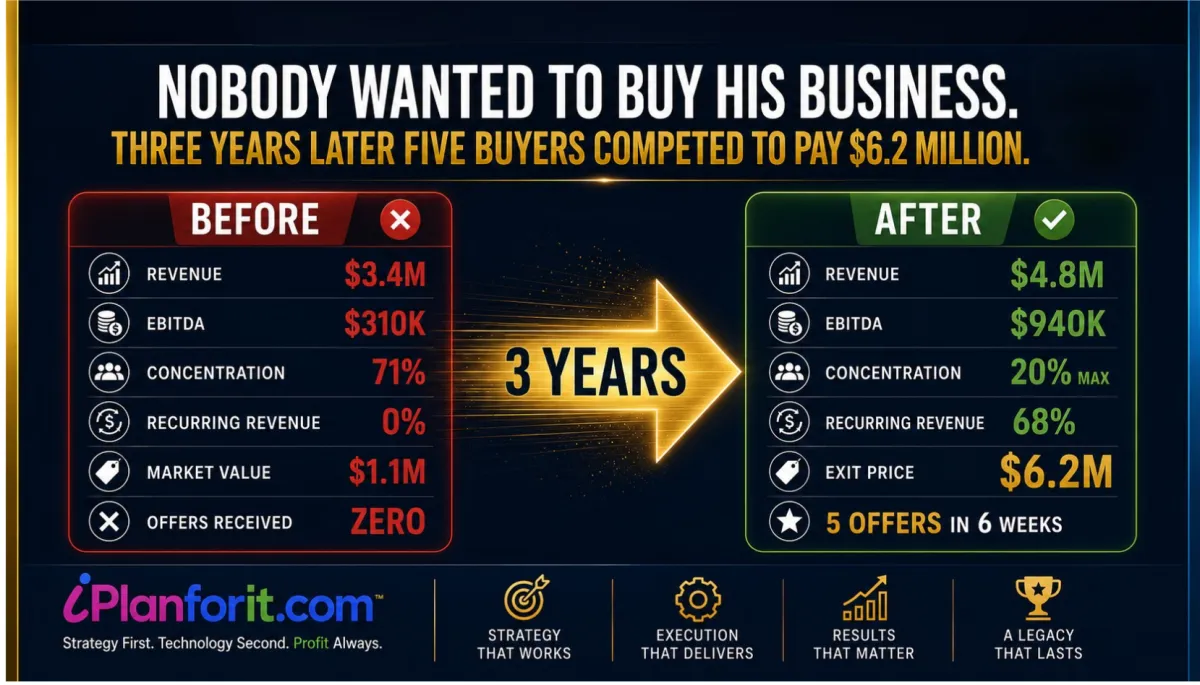
When Maurice came to us, he had already tried to sell his commercial landscaping company once: eight months on the market, zero offers, and a broker who eventually stopped returning his calls. His revenue was $3.4 million, he had been in business for nineteen years, and he had loyal customers and a crew he trusted. By every measure he could see, he had built something real. What he could not see was why buyers kept walking away. Our value gap analysis told the story immediately: Maurice was the business. Three clients represented 71 percent of his revenue; his financials mixed personal and business expenses that would have stopped any due diligence review cold; he had no documented systems, and no management layer that could operate without him on the other end of a phone. His first broker had listed him at $1.8 million and found no takers.

Our assessment put fair market value closer to $1.1 million, not because the business was bad, but because it was invisible without its owner standing in front of it. Over the next three years, we rebuilt it from the inside out: we hired and developed an Operations Manager, restated three years of financials to reflect a true normalized EBITDA of $580,000 nearly double what the raw books showed converted the top fourteen accounts to annual contracts, diversified the customer base until no single client exceeded 20 percent of revenue, trademarked his proprietary service program, documented every operational process, and built a data room that was buyer-ready twelve months before we went to market.

By the time we launched the sale process, revenue had grown to $4.8 million, EBITDA had reached $940,000, and the business ran without Maurice. Five letters of intent came in within six weeks. The winning offer: $6.2 million, a 6.6x multiple from a private equity-backed regional platform that paid a premium precisely because of everything we had spent three years building. The preparation added $4.4 million to his outcome. He retired at sixty-one, paid off his home, funded his daughters' education, and his Operations Manager was retained, given equity, and promoted to Regional Director within six months of close. That is what Strategy First looks like when it is done right.

Over the years I've watched business owners celebrate one of the biggest financial victories of their lives, and then quietly struggle in the months that followed.
Not because they made a bad deal.
Because they never prepared for the day they were no longer "the owner."
A successful exit isn't just measured by the wire transfer.
It's measured by the quality of the life you build afterward.
That's why, at iPlanForIt, we prepare our clients for both.
Strategy First. Profit Always.™
Schedule your complimentary 15-minute strategy call at iplanforit.com/strategy-call-15min
© 2026 Exit Strategy Experts. For informational purposes only. Consult qualified legal, financial, and tax advisors before making any exit planning decisions.

Driving Growth, Amplifying Impact

Unleash Your Business Brilliance.
We uncover hidden profits, reduce expenses, implement AI systems, and help owners build more profitable, valuable, transferable companies.
We believe every business has untapped profit potential.
Our mission is to help business owners uncover it, accelerate growth, increase profitability, and build more valuable, scalable, and future-ready companies.