



See Our Latest Posts and News
Access our FREE Articles and Learning Library of content
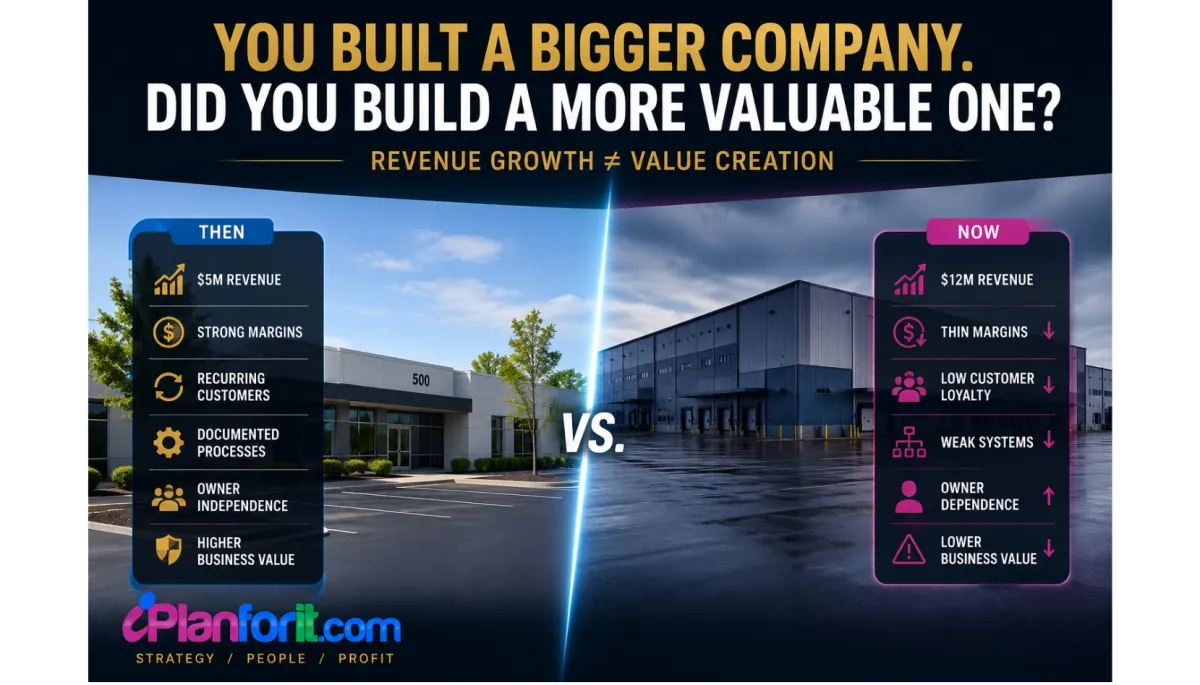
Your Business Is Growing. But Is It Becoming More Valuable?
Business Strategy, Company Valuation
Growth is exciting.
Revenue climbs. New customers arrive. Employees get added. The company moves into a larger facility. Another location opens. The organization becomes busier, more visible, and, at least from the outside, more successful.
But there's a question business owners don't ask often enough:
Is all of that growth actually making the business more valuable?
They are not the same thing. A company can double its revenue without doubling its value. It can become larger while becoming more complicated, less profitable, and more dependent on its owner. And sometimes the growth everyone is celebrating is quietly exposing weaknesses that will eventually limit the company entirely.
Revenue is important. Every business needs it. But revenue alone tells us remarkably little about the actual quality of a business.
Imagine two companies producing exactly the same annual revenue. One generates strong margins, has predictable recurring customers, operates through documented processes, maintains a capable management team, and can function without the owner being involved in every decision. The other has thin margins, inconsistent cash flow, a handful of customers that represent a large share of sales, weak systems, and an owner working 60 hours a week, holding it all together by hand.
Same revenue. Very different businesses. And very possibly, very different values.
I've spent more than four decades around businesses, and one pattern keeps showing up: success can hide inefficiency for a surprisingly long time. When revenue is growing quickly, there's enough momentum to compensate for many underlying problems. An inefficient process just gets another employee thrown at it. A weak sales system gets more marketing dollars instead of a fix. Poor customer profitability gets buried under total revenue. Owner dependency gets relabeled as commitment. As long as the top line keeps moving upward, those decisions can feel perfectly reasonable.
Eventually, complexity catches up anyway.

The Owner-Dependence Test
There's a simple question I believe every owner should ask themselves occasionally:
What happens to this company if I disappear for 90 days?
Not a vacation where you're still quietly answering emails. Not checking in every morning "just in case." Completely, genuinely unavailable.
Would customers continue to receive the same level of service? Would employees know exactly what decisions they're authorized to make without you? Would sales continue? Would financial performance stay visible? Would your key relationships survive without you personally maintaining them?
The more a business depends on its owner for daily decisions, customer relationships, institutional knowledge, and problem-solving, the harder it becomes to separate the company's value from the value of the person running it. That distinction matters long before anyone's thinking about a sale. A business that can operate independently gives its owner something genuinely valuable: choice. The choice to expand. The choice to step back. The choice to bring in outside leadership. The choice to pursue something new. And eventually, if you want it, the choice to sell.
Five Questions That Test Whether Growth Is Creating Value
Are profits growing faster than revenue? If revenue is up but margins are flat or shrinking, you may be buying growth at the direct expense of value.
How dependent is the business on you, specifically? If sales, key relationships, and most real decisions all run through you, a buyer sees risk where you see stability.
Do you have recurring or repeatable revenue? Subscriptions, contracts, and genuinely loyal repeat customers can make future revenue more predictable, and that predictability can materially strengthen a business's valuation.
Are your processes documented and scalable? A business that runs on systems rather than heroics is easier to grow and far more attractive to future investors or buyers.
Is your customer base diversified? If a small number of clients account for a large share of revenue, the business can appear fragile, even while it's growing quickly on paper.
Pro Tip: Track not just how fast you're growing, but how efficiently you're growing. Watch profit margins, customer retention, and owner dependency right alongside your top-line revenue, not after it.

Profit Quality Matters More Than Growth Speed
More revenue doesn't necessarily create more value if each additional dollar requires disproportionately greater expense, more people, more complexity, or more working capital to produce. This is exactly why improving the economics across a business can be more powerful than pursuing growth at any cost.
This is one of the reasons we use the Profit Accelerator Framework at iPlanForIt. Instead of looking at growth as a single revenue target, we examine the individual economic drivers inside the business—pricing, conversion, retention, transaction value, operating costs, productivity, margins, and other areas where relatively small improvements can compound. The objective isn't simply to make the company bigger. It's to improve the economics underneath the growth so the business becomes stronger and, ultimately, more valuable.
Better pricing discipline. Stronger customer retention. Improved conversion. More productive employees. Lower unnecessary costs. Better purchasing. More profitable customer relationships. More recurring revenue. Individually, none of these looks transformational on its own. Collectively, they can materially change a company's economics, and better economics tend to create better strategic options down the road.
Predictability Has Value of Its Own
Owners naturally focus on what their company earned last year. A future buyer, investor, or successor is going to be just as interested in something else entirely: how confident can I be about what this business will earn next year?
That single question changes the whole conversation. Recurring customers matter. Contracted revenue matters. Retention matters. A diversified customer base matters. Consistent margins matter. Reliable financial reporting matters. Repeatable processes matter. A capable leadership team matters. Every one of these characteristics reduces uncertainty, and uncertainty is one of the biggest enemies of business value. The easier it is for someone else to understand how your company produces results, and why those results are likely to continue, the stronger that business becomes as an actual asset.
The good news is that you can intentionally steer growth toward value instead of just chasing size. That means:
Focusing on ideal customers who are genuinely profitable and loyal, not just anyone willing to buy.
Investing in systems, technology, and training that make the business less dependent on any one individual, including you.
Building recurring revenue streams wherever it makes sense: maintenance plans, subscriptions, retainers, long-term agreements.
Monitoring the real value drivers: margin, churn, customer concentration, cash flow, not just sales volume alone.
Key Takeaway: Growth becomes genuinely powerful when it's profitable, repeatable, and transferable to someone other than you.
Owners often only start thinking seriously about business value when they're approaching retirement or considering a sale. I believe that's too late. The best time to build a valuable company is while you still fully intend to own it, because nearly everything that makes a business more attractive to a future buyer also makes it better for the current owner. Stronger margins create more cash today. Better systems reduce chaos today. A stronger management team reduces your dependence today. These aren't simply exit strategies. They're just good business strategies, full stop. Even if you never sell the company, you still benefit from building one that could be sold.

Don's Perspective
Perhaps we need to expand the way we define business growth in the first place.
Instead of asking only "did revenue increase," ask: Did profitability improve? Did cash flow strengthen? Did customer concentration decline? Did recurring revenue increase? Did the company become less dependent on me? Did the leadership team get stronger? Did operations become more repeatable? Did the business get easier to run? And ultimately: did the company actually become more valuable?
Those questions create a very different conversation around the executive table than the one most owners are having.
Revenue growth is absolutely worth celebrating. But after more than 40 years of watching businesses grow, struggle, evolve, and sometimes change hands entirely, I've come to believe the real objective was never simply to build a bigger company.
It's to build a stronger one.
Because someday, whether you sell it, transfer it to family, bring in new leadership, or simply want more freedom from it, the quality of the business you've built will matter far more than how busy it became along the way.
Don Miller, Founder & CEO | iPlanForIt
Helping business owners build more profitable, valuable, and transferable companies.
Strategy First. Profit Always.™
© 2026 iPlanForIt, Inc. All rights reserved.

Driving Growth, Amplifying Impact

CHOOSE HOW YOU WANT TO WORK WITH US
BUILD A STRONGER, MORE VALUABLE BUSINESS.
We uncover hidden profit opportunities, reduce unnecessary expenses, strengthen operations, implement AI strategically, and help owners build more profitable, valuable, and transferable companies.
Our mission is simple: help business owners turn untapped potential into stronger performance, sustainable growth, and greater long-term enterprise value.