



See Our Latest Posts and News
Access our FREE Articles and Learning Library of content
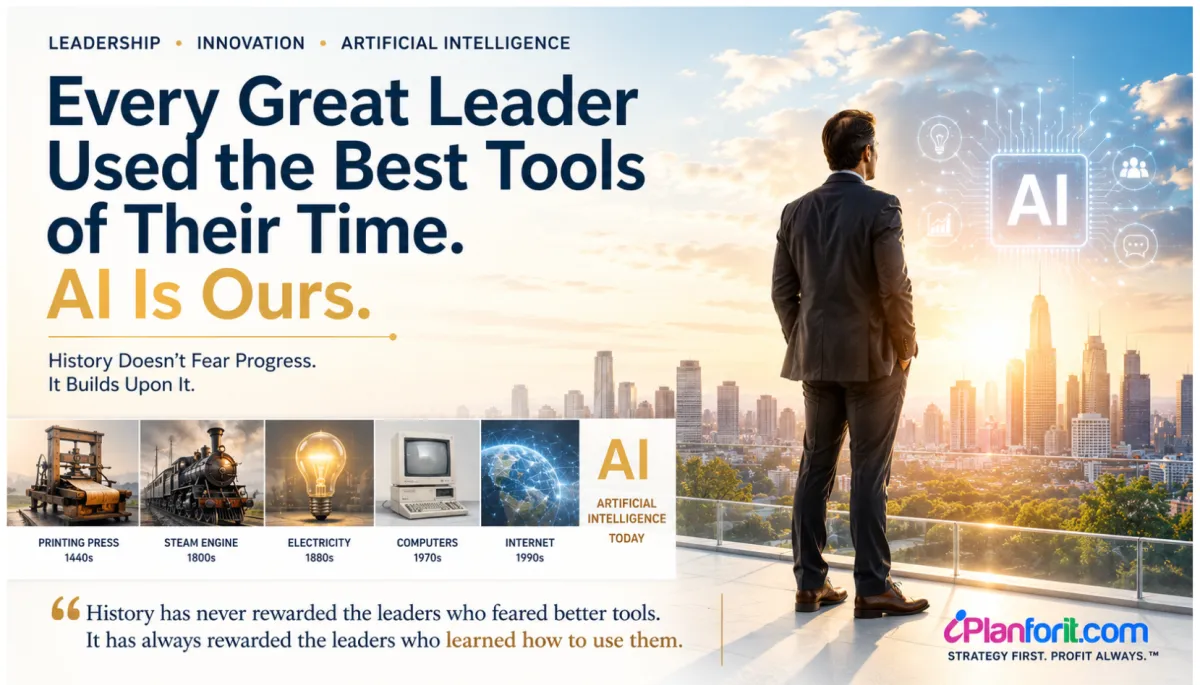
Every Great Leader Used the Best Tools of Their Time. AI Is Ours.
Leadership, Innovation, Artificial Intelligence
Every Great Leader Used the Best Tools of Their Time. AI Is Ours.
History Doesn't Fear Progress. It Builds Upon It.
Every Great Leader Used the Best Tools of Their Time
Every generation is remembered by the tools it embraced... and by the leaders who had the courage to use them wisely.
Imagine telling Henry Ford not to use the assembly line because people were afraid of change.
Imagine telling Thomas Edison to stop experimenting because electricity seemed dangerous.
Imagine telling Steve Jobs that computers belonged only in large corporations.
History would remember those decisions very differently.
Every generation faces a moment when a new tool challenges the way work has always been done. The leaders who changed the world weren't the ones who resisted those tools. They were the ones who learned how to use them responsibly.
Today, AI is our generation's defining tool. The question isn't whether it will change the world; it already has. The question is whether we'll choose to lead with it, or spend the next decade explaining why we waited.
One of the biggest misconceptions I hear is that AI somehow replaces human intelligence. I don't see it that way, and history doesn't support it either.
Throughout history, the best leaders never tried to know everything themselves. They surrounded themselves with advisors. Mentors. Specialists. Teachers. People who could challenge their thinking before a bad decision ever left the room.
Most of us have never had instant access to that kind of counsel whenever we actually needed it. AI changes that. For the first time in history, every entrepreneur, every manager, every student, every employee can have something that looks remarkably like an always-available thinking partner not someone who makes the decision for you, but someone who helps you think it through before you make it yourself.
That changes everything about how a leader prepares, learns, and makes decisions.

History Doesn't Fear Progress, People Do, At First
When we look back, progress always seems smooth and inevitable. In the moment, it never felt that way to the people living through it.
The printing press was accused of corrupting culture. Early trains were said to move so fast they'd damage the human body. Computers were dismissed as a passing fad, useful only to large institutions with money to waste. Every one of those objections felt completely rational at the time.
The internet followed the same path. Many feared it would destroy business. Instead, it created entirely new industries and connected the world in ways no one imagined.
History doesn't fear progress. People do, at first. But history has also shown us, over and over, that fear is never the final word. We debate. We regulate. We learn from our mistakes. We improve the tools we've built. AI is following that exact same path right now. The real question for leaders isn't whether the change is coming. It already has. The question is whether you'll help shape it responsibly, or watch it get shaped without you.
Key Takeaway: Progress is rarely comfortable in the moment. It is consistently transformative for the leaders willing to engage with it early and thoughtfully.
AI Doesn't Replace Wisdom. It Removes the Barrier to Asking for It.
Think about the questions we hesitate to ask. Questions we worry might sound too simple. Questions that show up at eleven o'clock at night, long after everyone else has gone home. Questions we don't want to ask our mentor for the fifth time.
AI removes that barrier entirely. It creates a judgment-free environment where curiosity has no ceiling, and the result isn't weaker professionals. It's stronger ones.
A young manager can practice a difficult conversation before having it for real.
A CEO can pressure-test strategic assumptions before ever bringing them to the board.
A business owner can explore twenty different ideas before risking capital on one.
An employee can understand a financial report, sharpen a presentation, or prepare for a promotion without waiting on someone else's calendar.
AI doesn't remove thinking. It multiplies the opportunities to think better, more often, and earlier before the stakes get expensive.

New Tools Build on What Came Before. They Don't Erase It.
This is the part people get wrong most often. New tools have never erased what came before them; they've built on it. The calculator didn't eliminate the need to understand numbers; it let people handle far more complex calculations than they ever could by hand. Email didn't end writing; it expanded how quickly and widely we could communicate. AI works the same way. Used well, it doesn't erase human skill. It amplifies it.
Here's what AI still cannot do, and likely never will: it cannot provide the actual core of leadership. Vision. Values. Courage. Empathy. Accountability. It can draft you a hundred options in ten seconds. It cannot decide which future is actually worth building. That remains, entirely and permanently, a human choice.
Pro Tip: When new technology feels overwhelming, ask yourself one question: "How did the leaders before me respond when their world shifted?" The answer is almost never "by standing still."
The organizations that thrive in the years ahead won't be the ones with the most technology sitting on the shelf. They'll be the ones that pair that technology with curiosity, humility, and a genuine commitment to continuous learning. That combination, not the tool alone, is where real competitive advantage starts.
At iPlanForIt, we don't see AI as software. We see it as one of the greatest leadership development tools ever created.
Technology should never replace judgment. It should sharpen it. It should never replace relationships. It should strengthen them. It should never replace leaders. It should help leaders become more thoughtful, more informed, and more effective than they were the year before.
The businesses that embrace AI this way won't simply become more productive. They'll become more capable, and that's a very different, much more durable kind of advantage.

My Perspective
When I look back through history, I don't see leaders remembered for rejecting innovation. I see leaders remembered because they recognized opportunity before everyone else did.
The remarkable thing about AI isn't that it's intelligent. It's that it gives every one of us access to knowledge, perspective, and coaching at a speed no previous generation could have imagined. For the first time, a young entrepreneur has access to the kind of strategic thinking that once belonged only inside Fortune 500 boardrooms. A new supervisor can prepare for tomorrow's hardest conversation tonight. A business owner can challenge their own assumptions, explore real alternatives, and refine an idea in minutes instead of weeks.
That doesn't diminish human leadership. It elevates it.
The future won't belong to the people who know the most; knowledge is becoming more accessible than ever before. The future will belong to the people who learn the fastest, ask the best questions, and have the wisdom to combine technology with humanity instead of choosing one over the other.
That's why I believe AI isn't replacing the human experience. It's expanding it. And history has shown us this same lesson time and time again: every great generation leaves the world better because it learned to use the best tools available to it.
AI is simply our generation's opportunity to do the same thing.
History has never rewarded the leaders who feared better tools. It has always rewarded the leaders who learned how to use them.
Above all, remember: Every generation is given an opportunity to shape the future.
Ours happens to be called artificial intelligence.
The real question has never been whether new tools will change the world.
The question is what kind of leaders we'll become because of them.
History is still being written.
So is ours.
The leaders of tomorrow are preparing today.
Don Miller, Founder & CEO | iPlanForIt
Helping business owners build more profitable, valuable, and transferable companies.
Strategy First. Profit Always.™
© 2026 iPlanForIt, Inc. All rights reserved.

Driving Growth, Amplifying Impact

CHOOSE HOW YOU WANT TO WORK WITH US
BUILD A STRONGER, MORE VALUABLE BUSINESS.
We uncover hidden profit opportunities, reduce unnecessary expenses, strengthen operations, implement AI strategically, and help owners build more profitable, valuable, and transferable companies.
Our mission is simple: help business owners turn untapped potential into stronger performance, sustainable growth, and greater long-term enterprise value.